
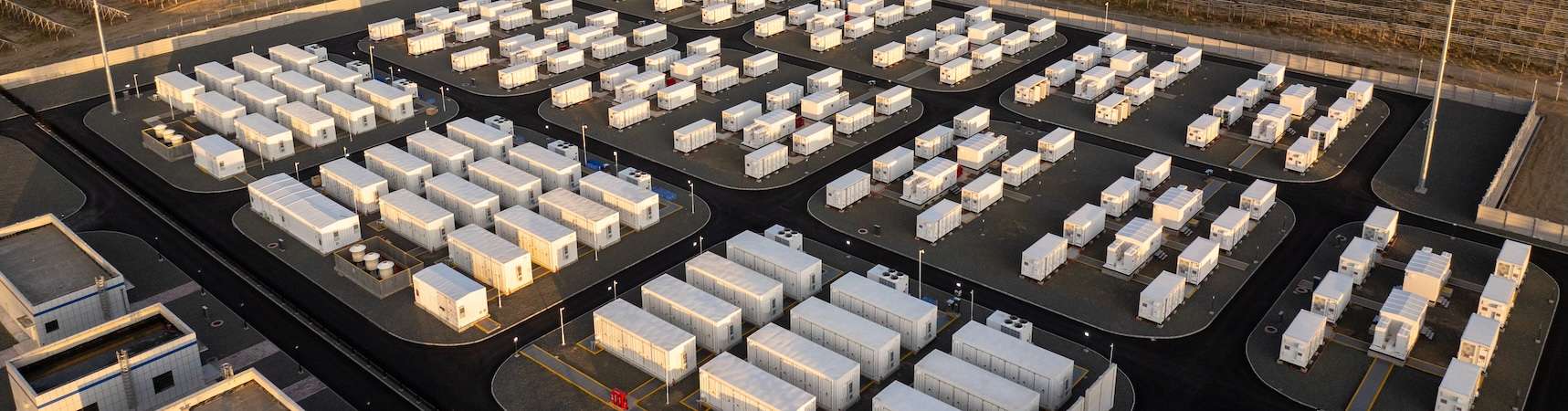
Whether you’re a developer, IPP, or utility, minimizing financial risks, winning each storage RFP, and ensuring strong project returns for standalone battery energy storage or solar + storage projects is much more complicated than for standalone solar. Energy storage technology is more complex, and its supply chain is more concentrated and volatile, including identifying domestic content options, making nearly every sourcing decision a web of interdependencies.
Critically, decisions made during one phase of the development timeline have ripple effects across the rest. The cost of a wrong choice shows up later as a blown schedule, an underperforming system, gaps in project scope and responsibility, or a project that loses its tax credit eligibility from poorly executed diligence. Even for experienced developers, the rapidly changing supply chain landscape means that energy storage projects are rife with unknown unknowns.
None of this means you need to become a battery engineer or a BESS supply chain expert to develop energy storage projects successfully: on time, on budget, compliant with sourcing requirements and positioned for strong returns. Anza’s Advisory Services provide critical expertise to close the gap, pairing BESS project developers and owners with experts who have supported more than 8 GWh of storage projects over the past year and worked directly with major BESS and PCS vendors across nearly 100 deployments.
Below, we walk through how our services team helps developer and IPP teams at each project phase: navigating and narrowing product options pre-procurement; testing assumptions and ensuring compliance before issuing a purchase order; and minimizing risks by identifying and pulling forward key construction and commissioning work.
Development: Explore and Derisk Your Options Before Deciding What to Buy
Developers spend countless hours estimating the financial viability of their assets, but don’t necessarily have the strongest information on hand to help minimize risks. Many only have a rough idea of how much energy capacity their site can support. Some rely on manufacturers or CAD companies with little energy storage execution experience to assemble conceptual drawing sets. Others still may not have a good view on the energy storage supplier landscape, with a clear understanding of current energy storage pricing, which OEMs are bankable, and which can supply systems that include domestic content.
Developers need to gauge numerous tradeoffs to choose a site configuration, including
- Deciding between an all-in-one AC and a self-integrated DC-block system architecture, both with different commercial wrap options, and each approach carrying a different cost, risk, and contracting schedule profile;
- A supplier’s bankability and the safety systems of their products, which are essential to ensuring the permitting approval and financeability of the project; and
- The suitability of suppliers, architecture, and available products along all of these criteria, which is as dependent on a developer’s in-house engineering capacity to assess as it is on price, timeline, and site constraints.
Having the right supplier and product data affects how well a proposed project will be positioned to win a storage RFP and secure financial surety. Pure-play developers competing in programs like Illinois’s Indexed Storage Credit (ISC) and Virtual Power Plant (VPP) energy storage procurements for example, where strike price and technical qualification matter, need a defensible basis for their bid, not a guess.
Anza can help teams in the development stage determine appropriate system sizing for a site, model the technical requirements a design will need to satisfy, and think through how AC- or DC-coupled solar-plus-storage should be configured for a given interconnection and use case.
Sitting on top of nearly every one of these decisions is ensuring FEOC compliance and, by extension, qualifying for the ITC. Battery cells alone can represent over half of a project’s material assistance cost ratio (MACR) – the key test for FEOC compliance – and Chinese ownership, IP licensing, and upstream material dependencies can all disqualify a seemingly compliant domestic product and introduce high levels of cost and schedule risk.
In addition, putting together a preferred vendor list requires knowing the right UL certifications to look for in terms of safety systems, cell/module and large-scale fire testing, and inverter and power converter integration. Those certifications are becoming key requirements not only for RFP processes but for permitting approvals in general.
Anza’s advisory teams help developers make informed product decisions that can withstand scrutiny, using real supplier compliance data and pricing to quickly identify FEOC-compliant and domestic content options that can be modeled into RFP responses, rather than relying on assumptions that may not hold by the time equipment ships.
In 2025, our team helped a developer keep a bid alive on a very tight RFP response deadline. Its team didn’t have current pricing or visibility into DC-coupled options, was relying on proposals from an outdated supplier list, and had no active procurement capacity to quickly connect them with suppliers.
Our experts stepped in quickly, reviewed the RFP’s parameters, and added clear language on how any downward adjustment in pricing would be handled between contracting and delivery. We supplied the developer with ready-to-model DC-coupled options and advisory support to meet the deadline, providing them actionable architectures with costs and capacity curves they could model the same day. We also drafted a safe harbor agreement and confirmed in-stock BESS to de-risk timing, cutting the developer’s overall RFP build time from 14 days to 3 days. As a result, the developer was able to submit two competitive DC-coupled bids, preserve their award eligibility, and set a clear path to safe harboring storage supply.
Procurement and Contracting: Testing Assumptions and Ensuring Compliance Before the Purchase Order
Once you have a supplier shortlist and your project is moving into procurement, it’s tempting to let capital cost drive decisions, especially under schedule pressure, but CapEx is only part of the risk picture. The terms and conditions in a supply agreement, the operating expenses and available capacity assumptions embedded in a long-term service agreement, and the scope of a commercial wrap all matter just as much to a project’s total lifecycle cost and risk exposure as the equipment’s sticker price.
Getting contracts settled and in place in a timely manner, with risks effectively captured and managed, is a marathon, not a sprint. Well-defined long-term service agreements and a clear understanding of warranty responsibilities within the overall commercial structure are critical to avoiding operational and maintenance risks that could hurt your project’s financial performance once deployed. When your procurement team has limited capacity, hands-on expert support can keep your project on schedule and on budget.
A supplier’s contract language regarding FEOC compliance is a good example: some manufacturers stand firmly behind their compliance representations, while others include carve-outs that allow them to substitute non-compliant components close to delivery if their preferred supply isn’t available. If a project’s financial model assumes ITC eligibility, that kind of language needs to be identified and negotiated well before signature, not discovered after the fact.
Anza’s advisory team works directly with customers on contracts and technical exhibits, providing expertise and support to guide them through the energy storage procurement process. Our team draws on relationships across the supplier landscape to keep negotiations moving, secure terms in the buyer’s favor, and review self-certifications to ensure FEOC compliance.
Renewable Properties, an IPP that develops, constructs, and owns small-scale utility solar-plus-storage projects, faced procurement delays and the risk of multimillion-dollar tariff cost spikes on a 4 MW / 16 MWh system. Because their key supplier’s contract template was designed for larger projects, securing revisions was slow. In addition, the procurement window overlapped with looming U.S. tariff increases. Missing the deadline would have escalated costs and jeopardized the project schedule, potentially derailing the entire mature project.
Our advisory team quickly engaged our OEM network and found a supplier with warehoused stock, which shielded Renewable Properties from tariff risks. Anza’s sourcing team leveraged our pre-negotiated contract terms to accelerate revisions, and we supplied Renewable Properties’ development and procurement teams with sizing, PCS/EMS/transformer specs, and a bundled, AC-wrapped system despite the project’s small size. Working side-by-side with the client teams and the OEM, we finalized commercial and technical terms in four holiday season weeks that included Thanksgiving and Christmas. As a result, Renewable Properties secured their equipment under budget, avoided multimillion-dollar tariff risk, and protected their project schedule.
Construction and Commissioning: Mitigating Risk Early Instead of Discovering It Late
As your project moves into final design review, confirming and validating EPC and vendor schedule feasibility as well as commissioning scope and schedule accuracy gives a project team a chance to catch problems while they still have time to plan appropriately, rather than after equipment has already shipped.
That same logic applies later in the process. By the time a project reaches construction, the biggest lever for reducing risk isn’t found on site. It’s in how much of the commissioning and integration work can get pulled earlier into the schedule, before crews are standing around waiting on equipment or documentation.
For example, lining up temporary auxiliary power for cold commissioning, inspecting fire protection systems early, and performing factory integration testing ahead of equipment arriving on site are all examples of work that are often not planned for in a timely fashion, but can, with the right planning, be addressed well ahead of mobilization. That can put weeks of float back into a schedule that otherwise would run tight.
In the lead-up to construction, Anza’s advisory team conducts reviews with all parties to ensure availability, delivery, and on-site schedules are in sync and reasonable before equipment ships. During construction, Anza’s advisory team supports the RFI process for product installation and reviews OEM-provided equipment parameters, since misconfigured settings at this stage tend to surface as performance shortfalls much later.
Commissioning is where many of these threads come together, and it’s also where developers new to storage often assume risks are already covered. Many EPCs and OEMs do offer their own commissioning support, and that support is real. But in many cases, that support is scoped to each party’s own equipment and contractual obligations, not to the project as a whole.
Anza’s role is to sit on the owner’s side of that table: reviewing vendor commissioning procedures and plans, validating site data, coordinating and tracking process steps and punch lists across all parties involved, while providing remote and on-site troubleshooting support when something doesn’t go according to plan. Gaps tend to show up at the seams between an EPC’s scope and an OEM’s scope, and that’s precisely where an independent, experienced advisor adds the most value.
GridStor, an independent power producer, was self-integrating a 220 MW, 2-hour system with less than a year to reach COD when the developer changed personnel mid-stream, requiring rapid knowledge transfer to maintain momentum on a massive utility-scale deployment. Differing requirements and approaches of the battery, inverter, and EMS vendors needed to be harmonized to sustain progress. Critical network equipment failures and telemetry misconfigurations necessitated prompt resolution to maintain the project’s commissioning schedule. All of these factors had the potential to delay COD and put revenue on key summer days at risk.
The IPP brought Anza’s advisory services team in to take the commissioning lead and manage daily project operations, coordinating across battery, inverter, EMS, EPC, and fire safety system suppliers.
- Before equipment even reached the site, Anza identified significant gaps in the vendors’ Factory Acceptance Testing (FAT) documentation and was able to direct the commissioning team to monitor specific flagged units during commissioning to proactively address potential impacts.
- To prevent repetitive installation errors across 204 containers, Anza recommended and oversaw a rigorous inspection of the initial installation, ensuring the first unit met strict quality standards before allowing the EPC to proceed with the remaining 200+ units, thereby protecting the schedule from widespread rework.
- Anza’s engineering team led the creation of the ERCOT commissioning plans, which were praised by ERCOT for their quality.
- In addition, Anza established daily progress tracking and hot commissioning workarounds to overcome obstacles and maintain the schedule, even when vendor equipment failed.
As a result, by coordinating multiple suppliers on a project spanning 68 inverter skids and 204 battery units, our team helped the project complete hot commissioning and ERCOT testing for the 440 MWh facility in just two months while the owner team stayed lean.
Reducing Risk Is a Continuous Process, Not a Single Decision
The developers who navigate energy storage projects most successfully to COD and beyond aren’t the ones who get every early decision perfect; in many cases, they have some of the needed expertise, but not in every area. The successful ones have a partner who can catch problems throughout the full lifecycle, from building the preferred vendor list during development through completing the last commissioning tests before COD.
Anza’s advisory team brings that continuity, backed by direct experience across the supplier and EPC landscape and by the same compliance and pricing data that powers Anza’s platform. If you’re weighing sourcing strategy for a storage project still in development, working through procurement and contracting, or trying to get ahead of construction and commissioning risk, watch our webinar recording to learn more about how our advisory services can support your next project.