
For many developers, securing the storage Investment Tax Credit (ITC) for projects coming online through 2030 is a key component of their business case. But with sourcing requirements added in 2025, your development and procurement teams have a new question to consider: whether pursuing the ITC makes the best commercial sense, as counterintuitive as that may sound.
While sourcing compliant components is complicated for solar buyers, the ITC’s Foreign Entity of Concern (FEOC) requirements pose a higher-order challenge for energy storage projects. Making the right decision about whether and how you can comply with the storage FEOC requirements means understanding your supply chain intimately and finding compliant options at the right price point.
Here’s what energy storage buyers need to understand about the ITC and FEOC compliance landscape — and why having the right information is critical for project success.
To ITC or Not to ITC, That (Should Be) the Question
In our earlier post on solar and the ITC, we walked through how the core FEOC compliance test for both solar and energy storage projects, the Material Assistance Cost Ratio (MACR), works in practice. For energy storage projects to qualify for the ITC, the test is the same as for solar, but with a higher threshold for compliance.
For 2026, battery-based energy storage systems must clear a 55% non-PFE threshold (as opposed to 40% for solar) — meaning at least 55% of a storage project’s cost stack must come from non-PFE sources. This rises to 60% in 2027 for non-safe-harbored projects working to meet the commenced-construction deadline, rising 5% each year after 2027, capping at 75% in 2030.
Meeting that threshold can be more challenging for battery storage projects, because the supply chain concerns span a wider range of cell and module designs, source materials, BOP components, and packaged solutions than for solar. In particular, the dependence on Chinese inputs, from raw materials to fully integrated battery storage solutions, is more extensive. As we noted during our recent webinar, battery cells and modules can represent as much as 52% of a project’s cost stack, making those sourcing decisions critical.
Whichever path you choose, there are only two potential outcomes: either a project clears the required non-PFE MACR threshold and qualifies for the ITC, or it doesn’t. Going a step further, a zero base ITC means your project can’t access the domestic content adder or the energy community adder either.
In short, your sourcing decisions don’t just affect your ability to secure the ITC; they can reshape your project’s entire economics. In some cases, the premium you avoid paying by using non-compliant choices may offset the loss of the ITC. Many developers never ask whether foregoing the ITC might be the smarter call, but with data from Anza’s platform, one of our customers, Standard Solar, did just that.
How the Right Data Streamlines ITC Go/No-Go Decision-Making
FEOC-compliant storage supply comes at a premium today. The size of that premium varies by supplier, product, and delivery window. For example, as of April 2026, the lowest risk FEOC products carry at least a $50/kWh cost premium, compared to high or highest risk FEOC offerings. If you don’t have visibility into both the compliance status and the cost across your options, you can’t make a rational decision about whether pursuing ITC eligibility is worth it for a given project. That’s not a philosophical question; if you don’t have real data to evaluate, you can’t know if your business case is realistic.
C.J. Calavito, general manager of integrated project teams for Standard Solar, shared on a recent Anza webinar how, with access to Anza’s platform, his company could easily model both options.
Anza’s platform automatically calculates the ITC benefit based on the domestic content of selected equipment, including the domestic content adder if applicable. In one place, Standard Solar’s teams could see FEOC risk, tariff risk, and domestic content options that could meet their project needs, and how other available products that might not be eligible for the ITC would affect their system cost and lead time. In some cases, the equipment cost savings were greater than the ITC benefit. Setting aside the ITC, besides reducing costs, it reduced procurement complexity and provided a much wider range of provider and product options.
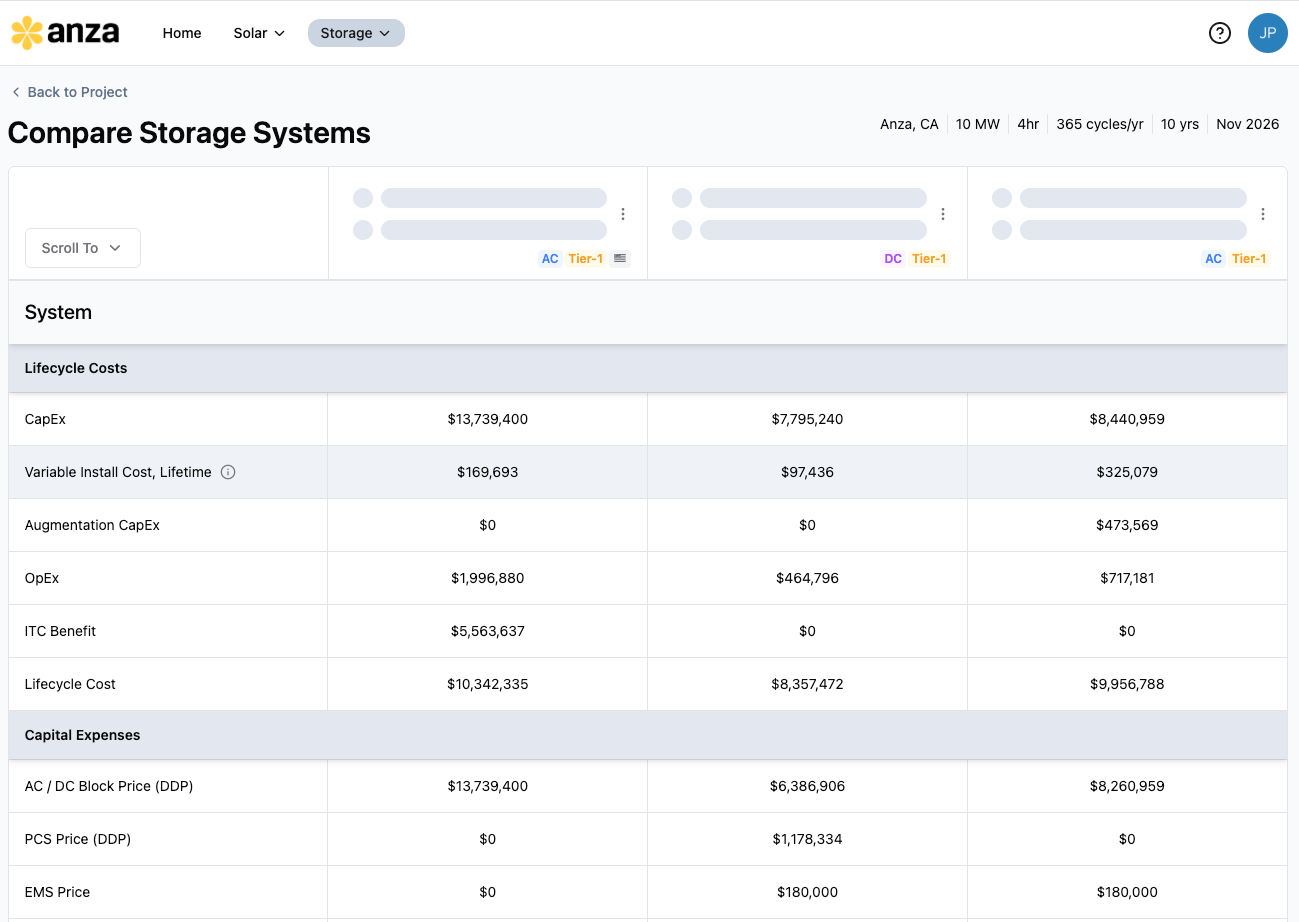
The comparison shown below illustrates exactly this dynamic for a 10 MW / 4-hour project in Anza, CA with a November 2026 delivery window. Three systems are shown side by side. The first is FEOC compliant and qualifies for the ITC with domestic content. The other two are not FEOC compliant and do not qualify for the ITC. In this example, you can see that the second and third options (DC or AC integrated) are cheaper from a CapEx and total lifecycle cost perspective. So, in this case, pursuing ITC and FEOC compliance does not make economic sense.
Why FEOC Compliance is Harder for Storage Than Solar
Once your team opts to pursue the ITC for a storage project, you need to understand and navigate the sourcing factors that may affect your ability to meet the FEOC 55% non-PFE requirements in 2026 and higher levels moving forward. Projects safe-harbored before the FEOC rules took effect may be exempt, but any new procurement is subject to the current and future thresholds. The challenge is that the energy storage supply chain has three structural realities that make compliance genuinely difficult — not just administratively, but commercially.
Factor #1 – China’s dominance in global battery cell manufacturing. While non-Chinese manufacturing capacity is being developed in the U.S., Southeast Asia, the Middle East, and Africa, it remains limited and comes at a price premium. For most buyers procuring supply through 2028 or even 2030, Chinese-manufactured cells largely remain the default unless you actively seek out alternatives. Battery cells alone can represent 52% of the FEOC cost stack under the safe harbor tables, which means that if your cells come from China, your MACR is almost certainly below the required threshold.
Factor #2 – Battery technology IP is largely Chinese-owned. Even when a manufacturer is not Chinese-owned and doesn’t operate in China, FEOC risk doesn’t disappear. A significant portion of LFP (lithium iron phosphate) technology IP is still Chinese-owned. Exclusive IP licenses from covered entities can still create effective control exposure — and therefore PFE risk — regardless of where the product is actually made. This is one of the most misunderstood dimensions of storage FEOC compliance.
Factor #3 – Upstream bottlenecks. Nearly all upstream processing for LFP chemistry — including cathode and anode active materials, electrolytes, separators — remains concentrated in China. While these upstream inputs don’t appear directly in the Treasury’s manufactured product component tables, they carry real risk in two ways. First, if a domestic manufacturer is heavily dependent on Chinese upstream suppliers, that dependency could constitute effective control exposure. Second, any inability for manufacturers to access the 45X manufacturing tax credit — which upstream reliance can threaten — creates pricing risk for buyers. A supplier’s costs, and therefore your equipment price, can shift materially if their 45X access is compromised.
Decoupling the end-to-end battery supply chain from China is a long process. However, to secure the ITC, buyers procuring for near-term delivery need to navigate these realities now, rather than wait for the supply chain to resolve itself.
Additional ITC Risks Beyond Cost & FEOC Compliance
In addition to some of the risk areas we covered in our earlier post on solar & FEOC compliance – including tax equity terms, insurance premiums and availability, and equipment cost premiums – there are other risk areas that should factor into your ITC decision-making for energy storage projects as well:
Contract terms for storage supply can leave you exposed. Supplier contracts vary significantly in how FEOC compliance is represented and warranted. Some manufacturers take strong positions on compliance. However, others include carve-outs that allow them to notify you of compliant component unavailability close to delivery, allowing them to substitute potentially non-compliant options. In addition, another major contract risk is that suppliers are unlikely to agree to indemnification clauses. If your project financial model assumes full ITC eligibility, contract language that weakens that assumption is a serious risk that needs to be identified and negotiated before you sign.
Operations and maintenance services can bring additional layers of long-term risk. Payments for warranties, augmentation needs, and future O&M services under long-term service agreements (LTSAs) can impact not only FEOC compliance in the near-term, but can affect your ability to fully realize 10-year tax credit recapture.
Lastly, compliance is not a static process. Suppliers are actively evolving their supply chains, forming new manufacturing partnerships, and making progress – and in some cases, encountering setbacks – on their FEOC compliance roadmaps. A supplier that was high-risk six months ago may be on a credible path toward compliance. One that appeared compliant may have a new upstream dependency that changes the picture. Assuming compliance status at one point in time is not the same as assuring compliance status at delivery.
Anza’s Risk Framework: Making the Assessment Actionable
To help storage customers navigate this complexity, Anza has developed a four-tier FEOC risk rating for energy storage suppliers — Low, Medium, High, and Highest — based on three pillars: ownership, effective control, and manufacturing location.
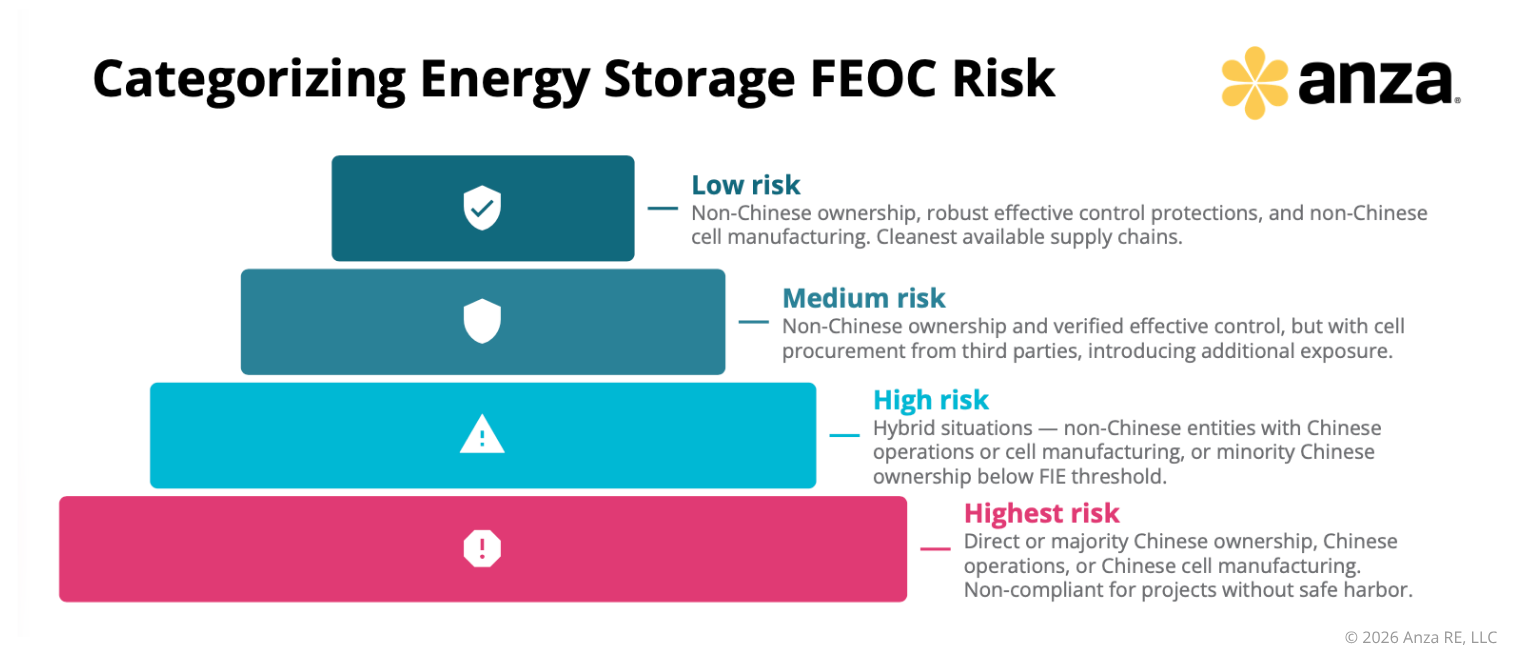
Cell manufacturing location serves as a proxy for MACR under the safe harbor tables. It’s the single highest-leverage data point in a storage FEOC assessment — and the one most worth verifying rigorously.
How Our Energy Storage Pro Platform Simplifies BESS Decision-Making
As the example with Standard Solar above shows, Anza’s energy storage platform was built to make this assessment fast, financially grounded, and actionable — without requiring buyers to run a parallel supplier RFP every time market conditions change.
For example, an Anza customer is already managing a 1.5 GWh BESS project pipeline with a team of one. Anza’s platform handles the heavy lifting of sourcing supplier data, allowing lean development and procurement teams to quickly find compliant supply options.
Set your project parameters once. When creating a project, you input your safe harbor date, ITC eligibility criteria, and FEOC risk tolerance. If your project was safe-harbored before FEOC rules applied, those considerations fall out automatically. If not, the platform applies the appropriate compliance threshold based on your delivery date.
Customize your own risk profile. Our platform lets you define which ownership types, effective control configurations, and cell manufacturing locations you consider ITC-eligible. This means you can quickly model conservative and aggressive FEOC assumptions side by side — and see the lifecycle cost impact of each.
Understand lifecycle cost with and without ITC — instantly. Every system in your results is ranked by lifecycle cost. ITC-eligible systems show the benefit applied; non-eligible systems show the unsubsidized cost. This gives you a true apples-to-apples comparison across suppliers at different FEOC risk levels, so the premium for compliant supply is visible in real dollars, not abstractions.
Supplier risk ratings and roadmaps. The platform surfaces Anza’s FEOC risk rating for each supplier, linked directly to the evaluation framework above. For buyers who need more depth — how a supplier is evolving, what their manufacturing roadmap looks like, what the questionnaire responses revealed — Anza’s Market Insights offering provides direct access to the sourcing team.
The platform covers 50+ battery storage products from 30+ suppliers and is updated continuously, so the picture you’re working from reflects where the market actually is — not where it was when you last ran an RFP.
Understanding whether to pursue the ITC for your energy storage project, and managing FEOC compliance risks once you do – doesn’t have a simple answer… but it does have a structured one. Making that assessment is a big challenge, and Anza’s platform is uniquely suited to help you understand your technology options and navigate risks. If you’re assessing supply for upcoming projects or trying to understand what your options will look like at different delivery windows, schedule time with the Anza team to see our energy storage platform in action and how it can help your development and procurement process.