
Storage demand has rarely been stronger. Data center load growth, utility procurement cycles, and grid operator capacity needs are all pulling in the same direction, with the pipeline reflecting it. What has changed is how much policy and regulatory turmoil has shifted a project’s economics and compliance needs between the day a developer signs a term sheet and the day it reaches notice to proceed.
Our last storage blog looked at the broad categories of risk a battery project carries today (i.e., financial, performance, and schedule) and how Anza’s Advisory Services help mitigate them. In this post, we look at sourcing risks, how to mitigate them during your product selection process, and how Anza’s energy storage data and analytics platform makes the process faster and easier. For example, ensuring your system of choice clears new and upcoming import restrictions, and securing optimal pricing and returns regarding the energy storage Investment Tax Credit (ITC). The pricing, supplier, product, and tariff data available through Anza’s platform turn moving policy constraints into something a development team can actually filter on.
The financial stakes aren’t abstract. FEOC compliance is what stands between a project and the base ITC, and layering the domestic content bonus on top carries its own premium. Domestic supply is tight enough that the alternative path, a non-Chinese but non-domestic system, may mean taking the adder out of your business case entirely. Equipment selection is no longer a procurement detail that gets settled late. It is one of the few decisions that can make or break your project’s economics.
The FCC inverter ban and EO 14421 add sourcing uncertainty, not a dead end
Two constraints are worth naming up front, because they now move as fast as the market itself. The FCC added foreign-produced power inverters to its Covered List in July of 2026, and Executive Order 14421 (aka the bulk power executive order), signed August 26, declared a national emergency over foreign-produced bulk-power system equipment and explicitly named battery energy storage systems and grid-connected inverters. These two federal actions are related but distinct, and the differences matter for how a team should respond.
The FCC action is already in effect: it bars new equipment authorizations for foreign-produced power inverters, and the August 20 update expanded the scope to include inverters with wired connections, not just wireless ones. It does not revoke existing authorizations or force anyone to remove installed equipment. In addition, a companion waiver preserves manufacturers’ ability to push firmware and security updates through at least January 1, 2029. “Foreign-produced” is tied to the federal Buy American domestic end product standard, which looks at where a device is actually built and how much of its cost is domestic, not where the manufacturer is headquartered. Limited U.S. final assembly of otherwise imported components may not clear it.
EO 14421 is broader and slower. It applies to equipment interacting with transmission at 69 kV and above, covering battery storage systems, inverters, substation transformers, and generation turbines and reactors. It reaches associated software, firmware, and remote access capability. It also authorizes conditions on equipment already installed, which is a meaningfully different posture than the FCC’s. Most of the operational detail is still being written: the Department of Energy (DOE)’s implementing rules are due by December 24, 2026, and the scope will depend on the covered-entity list DOE produces.
What a developer can do today is screen for it. Anza tracks equipment authorization status and covered-entity exposure at the supplier and product level for the FCC rule. That means a shortlist can be tested against it before a project reaches active procurement, rather than after a supplier is selected and a schedule is built around them. Anza’s platform currently distinguishes compliance in two ways: Exempt systems (i.e., domestically produced) and those with Supplier Declaration of Conformity (SDoC). Once DOE issues its rules in December, Anza will update its data and filtering to cover those requirements as well.
Making the ITC and FEOC call faster, and with more confidence
The question of whether to pursue ITC and then FEOC compliance is a different kind of problem. The FEOC compliance threshold keeps moving year on year. For energy storage, at least 55% of a project’s costs must come from non-prohibited foreign entity sources for a 2026 construction start, rising to 60% in 2027 and reaching 75% for projects beginning in 2030 and after. A system that comfortably clears today’s FEOC compliance bar can fail a start date three years out, so the analysis must be run against the project’s actual commence-construction year, not a general sense of whether a supplier is compliant.
If you’re unfamiliar, the types of FEOC compliance, seen below, refer to the entity-level and supply chain tests defined in the OBBBA: assessing whether the supplier is a Specified Foreign Entity (more than 50% owned or controlled by, or otherwise tied to, China, Russia, North Korea, or Iran); whether it is a Foreign-Influenced Entity (at least 25% owned by a single SFE, at least 40% owned in aggregate by SFEs, or with at least 15% of its debt held by SFEs); and whether a prohibited entity holds effective control through board seats, senior executive roles, licensing, debt terms, or contract rights. Anza’s sourcing team requests this documentation directly from suppliers and reviews each submission against these tests.
Anza breaks down FEOC compliance status on our energy storage platform into six categories, based on our extensive experience and expertise navigating procurement issues with both suppliers and customs authorities. The six categories below range from the weakest (and therefore highest risk), Not Compliant, to the strongest and lowest risk: having a formal third-party Legal Opinion Available. The strongest provided documentation sets the supplier’s FEOC Compliance tier.

Compliance is achievable, but it requires component-level sourcing visibility and decisions rather than brand-level ones. Across the energy storage products Anza tracks, the distribution is sharply split, with 40% of products in the high FEOC risk categories (Self-Reported, Not Compliant) and 25% of products in the low-risk categories (Certificate Available, Legal Opinion Available, or 3rd Party Audited), with roughly 35% of solutions still Pending as diligence is being completed.
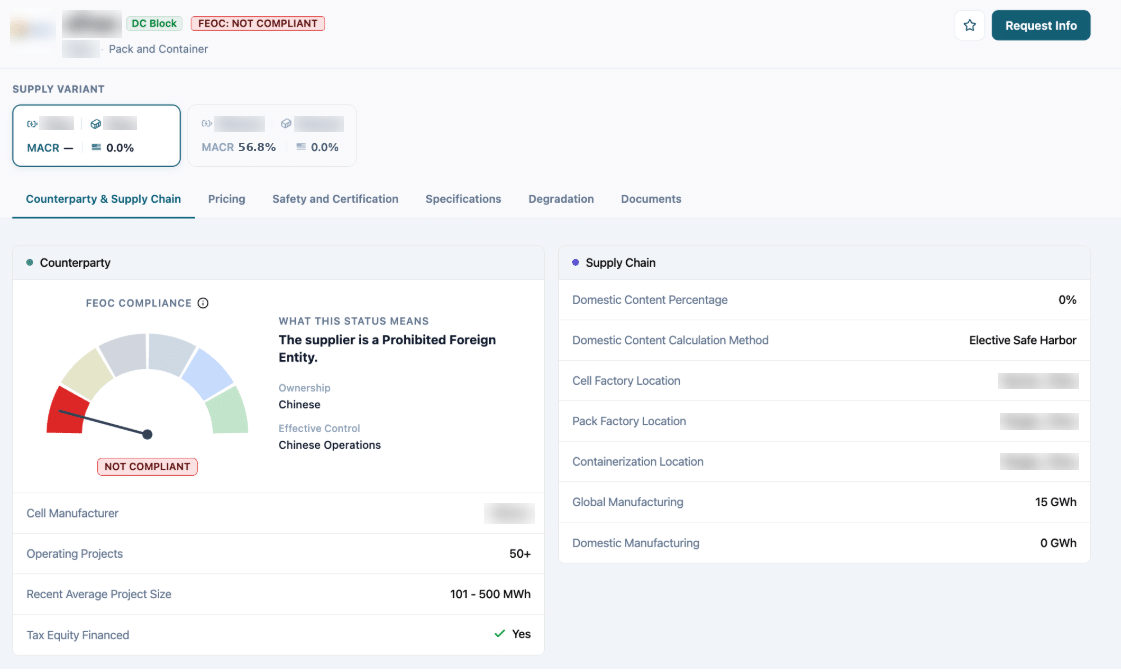
In addition to compliance status, your analysis should also consider which suppliers have domestic content options available, what premium those options carry, and what domestic content percentage they supply versus what is required to qualify for the 10% bonus.
That split is exactly why the real question buyers face isn’t simply whether compliance is possible; it’s what premium you must pay for it, and whether your options allow you to access the domestic content adder. Those answers let you determine whether that premium, including to secure domestically produced content, beats the alternative of a cheaper non-compliant system with the tax credit – and the 10% adder – written off.
Anza’s ITC modeling runs that comparison directly in the platform on a lifecycle cost basis, so the go/no-go decision comes from a model rather than a spreadsheet assembled by hand from out-of-date assumptions or supplier claims.
You can see FEOC compliance and domestic content offerings by supplier or product; understand how many MACR points a particular solution (or variant) contributes toward your target threshold; custom-build your project scenario, including filters for FCC inverter compliance status and a minimum FEOC compliance level; and gauge how many MACR points the solution contributes towards the DC adder.
From market view to shortlist
None of this information is useful if it arrives at the wrong point in the development cycle. Anza’s platform is built around the questions asked throughout each stage, taking you from a market-wide view down to a defensible shortlist.
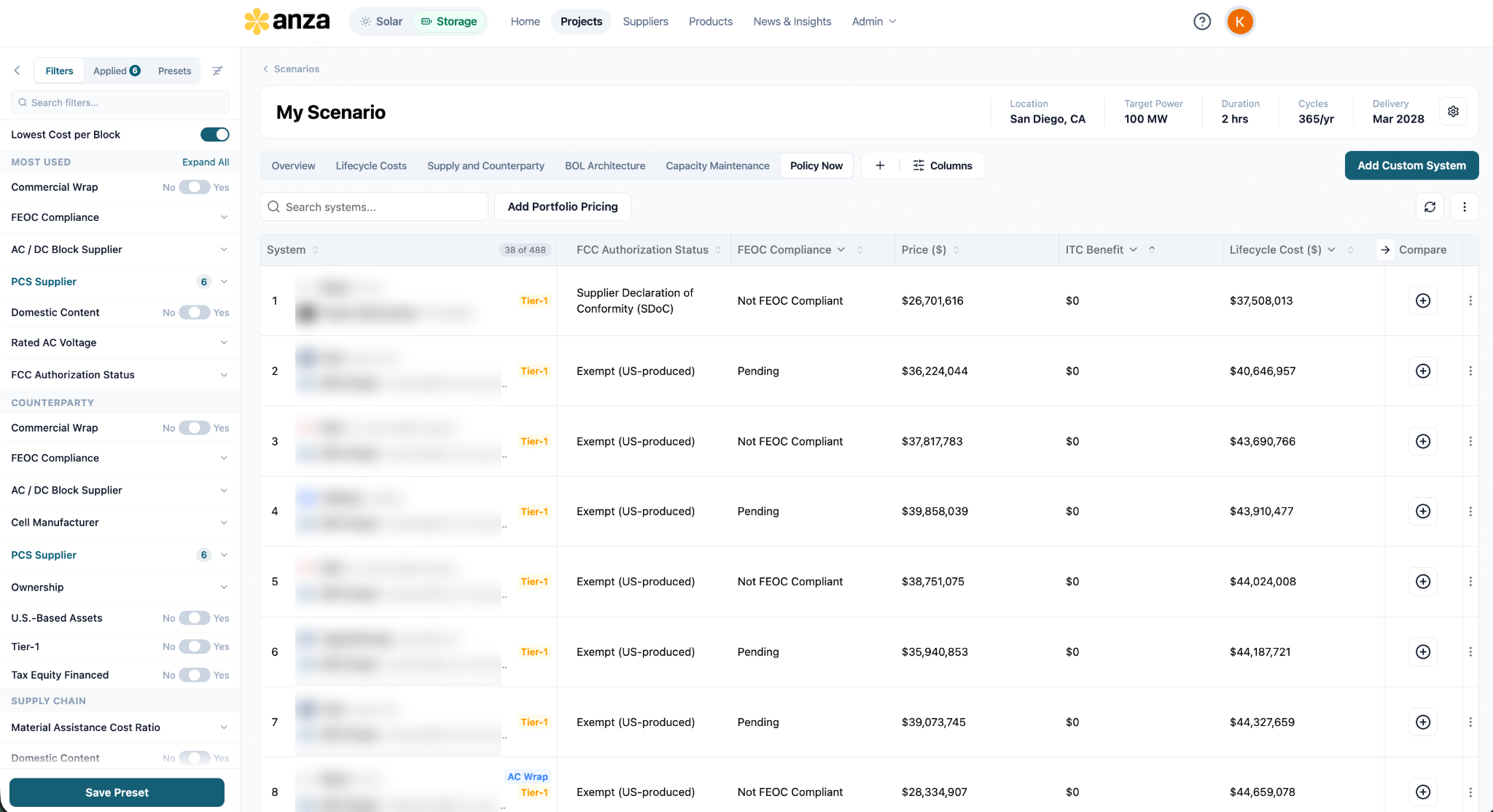
The first question the Anza platform helps you answer is simply which products are still on the table. Product and supplier filtering and library pages surface FEOC compliance tier, domestic content status including MACR points contributed to DC adder eligibility, FCC inverter compliance, bankability data, and safety certifications. This data lets a team map the full range of viable compliant options rather than discovering a constraint after a preferred vendor list is already circulating. In addition, you can seamlessly incorporate your own project-specific details and supplier information into scenarios to further modify your ITC eligibility. Downloadable documentation packages, including certifications and warranties, are available to meet AHJ expectations regarding NFPA 855 (2026) and the updated UL 9540A testing regime.
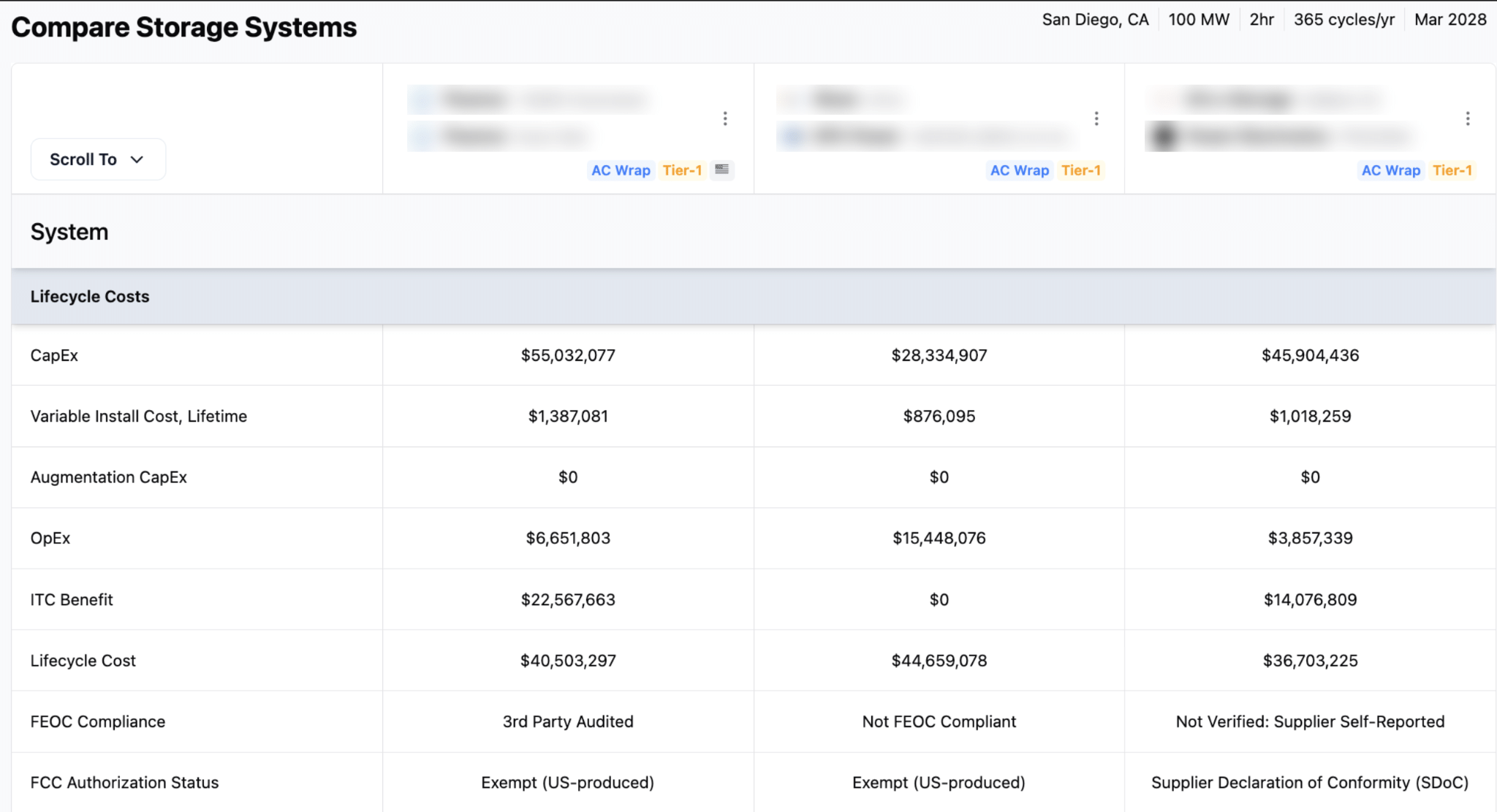
The second question the Anza platform helps you answer is which of those options provides the most long-term value over the project lifecycle, which is rarely the one with the lowest upfront price. If your development plan is opting for augmentation in future years rather than overbuilding or planning for long-term external servicing support, you need strong, validated data behind your modeling. Our lifecycle calculations take into account the net present value of your system’s CapEx, OpEx, and augmentation, including installation costs and ITC benefit if you opt for it.
By combining regularly updated supplier pricing and product data, including variants with domestic content options, Anza’s platform lets you compare apples-to-apples for capacity replacements or additions and model your desired servicing option. Automated lifecycle cost analysis, including augmentation schedules and capacity curves across the system’s operating life, separates a good number from a good decision.
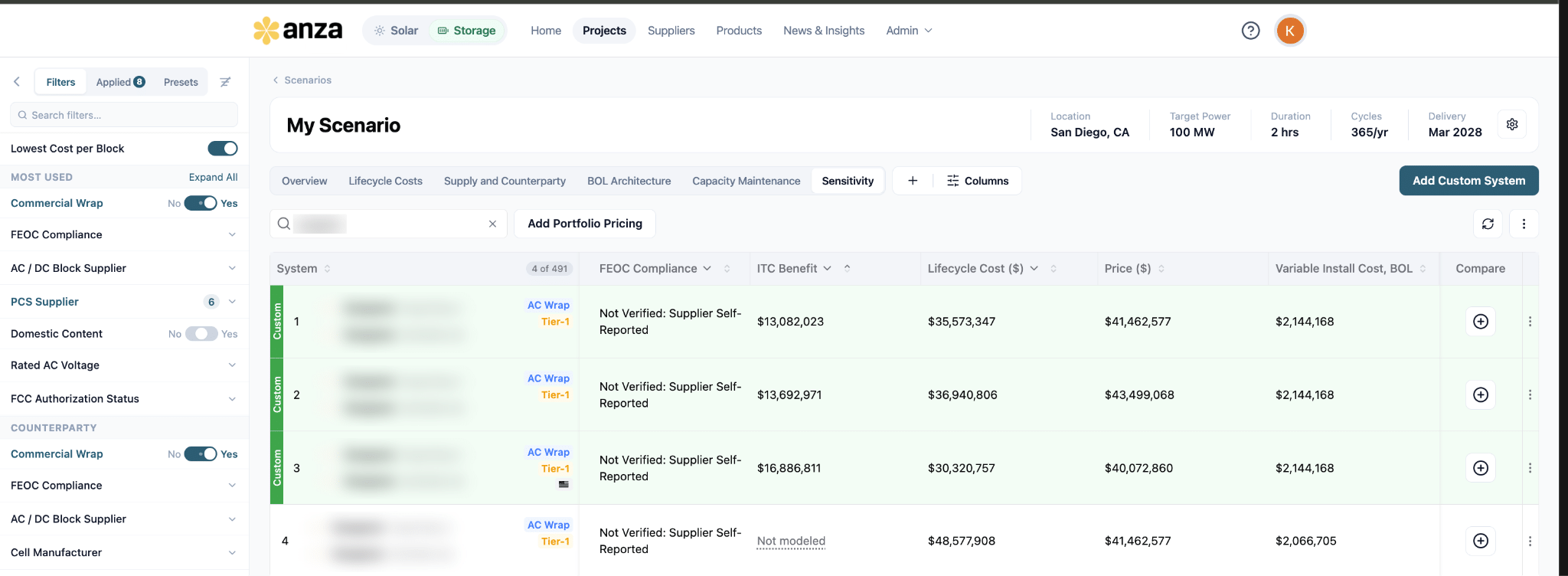
The third question is what happens if the inputs move. Scenario modeling in the Anza platform lets a team test sizing, duration, delivery timing, and tariff assumptions against each other. This helps developers and buyers better navigate a landscape where Section 122 tariffs have expired and been replaced by Section 301 forced labor duties, a further Section 301 round is anticipated, and a Section 232 action on batteries could come into play.
The bottom line
The policy environment won’t simplify soon. DOE’s rules implementing EO 14421 arrive in late December. Detailed IRS guidance on gauging effective control, a long-pending element of FEOC compliance, is expected around the same time. Each of these will change some input to a decision a developer is making right now. With all of the market and trade changes underway and on the horizon, making informed decisions about your project lifecycle costs with the best-available data and analytics is the best way to minimize risks.
That’s the case for building equipment selection: use market-wide, up-to-date pricing data from 85% of current suppliers, rather than what you can gather from a few supplier relationships and quotes that quickly become outdated. Anza’s platform consolidates risk, pricing, supplier, and product data in one place, so teams can make faster decisions with better support behind them and show their work when asked by a board, a lender, or a commission.
Join us on September 30 for a live walkthrough of the Energy Storage Pro platform, where we will show how these filters and models work on a real shortlist. Schedule a demo with our team to see how our storage platform can support your project or portfolio specifically.