

The July 4th safe harbor deadline has passed, but if you safe-harbored a solar project in 2024 or 2025, or are starting one in 2026 that beats the end-of-2027 placed-in-service cliff, you still have a key lever available to add project value: the domestic content bonus. As you can see below, with data taken from Anza Pulse, our on-demand solar module intelligence platform, the premium for U.S.-made modules is falling, quickly but unevenly across product types. That means the 10% domestic content bonus math just got more attractive, and because you can blend your way to the threshold, capturing it costs even less than the headline premium suggests.
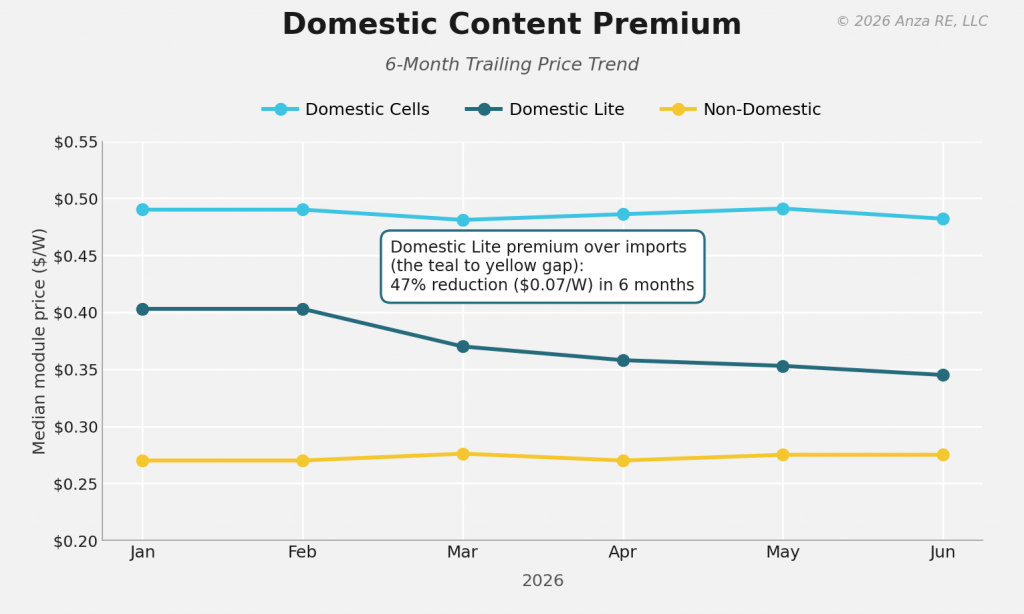
As of mid-June, Domestic Lite (modules with some U.S. made components, but not cells) carried a premium of about $0.07/W over comparable imports, down from $0.133/W in January, a 47% drop in six months. Domestic Cells held a larger premium of about $0.207/W, down 5.9% over the same period. The gap between non-domestic and domestic is closing faster for Domestic Lite versus Domestic cells. Read on to understand what’s moving, where it’s heading, and what to do.
Why the Domestic Content Premium Is Falling
Two different dynamics are driving the drop, and they are moving at different speeds.
Domestic Lite pricing fell first and fastest because standing up U.S. component manufacturing is far quicker and cheaper than building U.S. cell manufacturing. Domestic Lite manufacturers crowded in early and competed head-to-head with imports, and that competition has already squeezed most of the scarcity premium out of Domestic Lite modules.
Domestic Cells pricing is compressing more slowly than Domestic Lite because there is less U.S. cell supply, but that is starting to ease. The domestic cell field is already deep, with 19 suppliers offering domestic cell modules on Anza Pulse, and available volume from those suppliers builds over the next few quarters as new production lines ramp. Expect continued downward pressure on the cell premium, on a longer timeline than Domestic Lite.
Why You Should Lock In Your Options Now, Not Later
Timing is now a key factor: the premium for domestic content has already fallen far enough to make the domestic content bonus compelling financially, but even with new capacity additions, supply is starting to dwindle. Multiple manufacturers are already reporting selling out all Domestic Cells volume, and some have already sold out all Domestic Lite modules for the first half of 2027. Buyers are in a strong position now to reap the benefits of affordably priced domestic modules while availability holds out. Acting now, you can secure domestic content supply. In addition, if your project is planning to use TOPCon technology, be aware that the U.S. International Trade Commission is currently considering potential restrictions on the import of TOPCon modules under Section 337, which would take effect and hit the market in 2027. If you wish to use imported supply for your projects, you have a window but must act quickly.
What’s At Stake For Your Solar Projects
The domestic content bonus is the key lever left to improve your project economics to the tune of 15 cents per watt or more for most projects1 if your project is safe harbored and ITC eligible. You are probably shopping for modules now, and the pricing signal you have been waiting for has arrived. Understanding what the domestic content requirement actually means for your specific project, not just the general framework, is what turns that 15 cents per watt into captured value instead of money left on the table. Don’t forget to line up FEOC-compliant modules along the way. (New to the FEOC rules? See our breakdown of FEOC-related risks and how to avoid project exposure).
¹ The bonus is 10% of a project’s eligible tax basis, so its per-watt value depends on your project, and you keep that less the premium for domestic content. Anza’s solutions engineers calculate this with developers as a routine part of module selection. Not tax advice.
Accessing the Domestic Content Adder: A Blend Usually Beats Reaching for 100% U.S. Cells
The IRS requires domestic content ‘points’ to secure the domestic content bonus. Points are achieved by sourcing module components manufactured domestically in the United States. The IRS assigns different amounts of points to each module component based on the project type (e.g., 38 points for domestic cells on a ground-mount tracker project vs. 31.1 points for rooftop module-level power electronics (MLPE)). Optimizing the mix of international vs. domestic components can save you 10 cents per watt or more on the modules you buy.
This is how we define the three different types of modules with regard to equipment made in the U.S.:
- Domestic Cells modules use U.S.-made cells and carry the most domestic content points per module;
- Domestic Lite modules use imported cells but source at least one qualifying component domestically (for example: the frame, glass, backsheet, and/or encapsulant), supplying fewer points than Domestic Cells but costing much less, and
- Non-Domestic modules contain no components that qualify as U.S.-made, whether assembled overseas or in the U.S., and earn zero points toward the threshold.
The instinct among many development teams is to treat the domestic content requirement for solar panels as an all-or-nothing decision: either go for 100% domestic cells or do not bother. That instinct is likely costing your project money.
Many projects don’t need 100% domestic cells; they need just enough combined domestic content to clear the applicable threshold, which is 40% for projects safe-harbored in 2024, 45% for those safe-harbored in 2025, and 50% for 2026, rising further after that. On a standard solar tracker project, for example, racking and structural components alone typically contribute around 28.7 points before a single module is counted, so modules only need to bridge the remaining gap. Because Domestic Cells, Domestic Lite, and Non-Domestic modules can all be mixed on a single project, the optimization you want is the cheapest combination that clears that gap, usually a percentage of higher-point domestic modules blended with cost-effective imports. That blended price is the number that actually drives project cost.
Deciding between Domestic Cells and Domestic Lite options requires buyers to expand their analysis beyond module cost per watt, production value, and impacts on BOS & EPC costs. Buyers also must now consider multiple iterations of domestic content points as a key input to optimize their module investment decisions. For example:
- Domestic Lite is inexpensive, with a median price of about $0.35/W as of mid-June, down from roughly $0.40/W in January, but it only carries roughly 10-15 points, making it the cheapest way to close a small gap. It is a natural fit for a 2024 safe-harbored tracker project at the 40% threshold, and still viable for rooftop MLPE or string systems.
- Domestic Cell modules cost more, holding steady at around $0.48/W over the same stretch, but packs far more points into each unit, making it the more efficient choice if a project needs to source a large share of its points, generally 38 or more points from modules alone. But paying $0.48 for all domestic cells on a project is often overkill.
For most utility and commercial projects, reaching for 100% domestic cells isn’t necessary. The primary exception is for fixed ground-mount projects, where racking delivers zero domestic content points, but even those can benefit from blending internationally made modules with Domestic Cell modules that also have some domestic components. Almost every single ground-mount tracker and rooftop project we’ve analyzed for the domestic content bonus benefits from blending Domestic Cell modules with Domestic Lite or international modules. Some system types, like rooftop projects that carry few points from racking, do need most of their points from modules, but even those are best served by a heavy mix rather than an all-Domestic-Cells buy.
How to See Your Blend Before You Buy
The right blend will vary by project, so it pays to run a rigorous analysis for yours rather than default to a rule of thumb. Anza gives you a few ways to find the domestic content sweet spot for your project:
- Our free domestic content calculator, built using IRS Notice 2025-08 guidance, takes your broad project specs and returns the domestic content percentage you need;
- Anza Pulse provides live pricing spreads (P25 to P75 and medians), plus forward pricing for each module category;
- Domestic Content Mode in Anza’s Solar Pro runs the blend optimization for your specific project in minutes using live supplier data and regularly updated pricing data for hundreds of modules across the next 10 quarters, not a generic example; and
- Anza’s Advisory Services provides hands-on support, putting an expert on your team to help optimize your domestic content blending strategy.
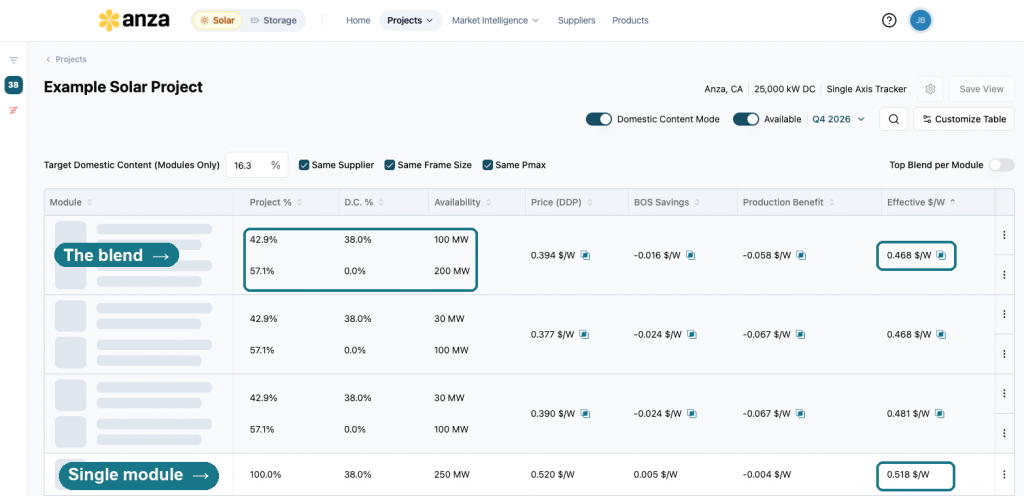
Anza’s Domestic Content Mode builds the cheapest compliant blend for a Q4 2026 tracker project: a 42.9% / 57.1% mix lands at $0.468 Effective $/W, below the $0.518 of the best single U.S.-cell module.
Here’s what domestic content blending looks like in practice using the Anza platform. In the example above, a tracker project taking Q4 2026 delivery needs 16.3 points of domestic content from its modules; the gap left after racking and inverters contributes about 28.7. Rather than opting for a single U.S.-cell module that clears the threshold on its own, the platform’s cheapest option blends two: about 43% of the volume from a higher domestic content module and 57% from a lower-cost import.
Anza ranks the options by its apples-to-apples cost metric, Effective $/W: a module’s delivered price adjusted for balance-of-system costs and expected energy production, so options compare on true installed value, not sticker price alone. On that measure, the blend lands at $0.468/W, below the $0.518/W of the single U.S.-cell module ranked fourth on the list with no blending. On a 100 MW project, that spread is worth $50,000/MW or roughly $5 million for the full project.
What This Looks Like on Real Projects
A solar project buyer wanted to know whether domestic content was worth pursuing across a safe-harbored portfolio, but with little direct OEM access, the team couldn’t easily prove it. Using Anza’s pricing and module data, they matched domestic options to the existing design and ran the cost delta through their own financial model. The answer: about 13¢/W of net upside, roughly $1.6 million across two projects. The math works at smaller project sizes too. A commercial real estate owner with a heavily safe-harbored DG portfolio needed less than a single point of domestic content from its modules. Running the blend on just one 1.5 MW project surfaced $78,000 in savings.
Getting domestic content right is not just an optimization problem; it is a compliance issue. The blend only pays if every point in it is real.
For example, a developer was recently finalizing contracts for roughly 260 MW of domestic content modules when Anza’s supply agreement review and due diligence flagged an issue: the supplier’s U.S. production started at metallization, skipping texturing, diffusion, and coating entirely. This could have jeopardized their supply’s qualification as domestic cells, potentially earning those modules zero domestic content points. This level of risk was beyond what the developer was comfortable shouldering. Luckily, the disqualification was caught before a single dollar was committed, so we were able to help them find an alternative that clearly satisfied full domestic cell production in the United States.
What to Do Next
To wrap up, three things are true right now: the premium for domestic content modules is falling, but unevenly, with Domestic Lite falling faster than Domestic Cells; domestic capacity is being committed quickly, which rewards buyers who lock in options early; and generally only ground-mount fixed projects (with no trackers) should consider 100% U.S. cells because Domestic Lite modules or international module blending can deliver massive savings.
Anza gives you the toolkit to act on all three points: the free domestic content calculator to size your exact domestic content target, Anza Pulse for live and forward pricing on every module category, and Domestic Content Mode in Solar Pro to run your project’s optimal blend against live supplier and module data, with Advisory Services behind all of it if you want expert help end-to-end.