

FEOC compliance has quickly become one of the highest-stakes concerns in solar procurement. Get it wrong, and you don’t just lose an Investment Tax Credit (ITC) adder — you could potentially lose your entire base ITC and put both your project and its economics at risk. With the solar safe harbor deadline rapidly approaching in July and the placed-in-service option for non-safe-harbored projects approaching at the end of 2027, the window to qualify near-to-medium-term projects for the solar ITC is narrowing quickly. Your team needs clarity on its component sourcing, not today, but yesterday.
The good news: the compliance framework is becoming clearer. The more difficult news: the risks that come with it are broader than whether a module has a FEOC compliance certificate attached to it.
Here’s what solar buyers and developers need to understand, and why having the right data platform in your corner matters more than ever.
FEOC Basics: What You’re Actually Being Asked to Prove
FEOC stands for Foreign Entity of Concern, broadly meaning any entity controlled by the governments of China, Russia, Iran, or North Korea. For tax credit purposes, what you’re being asked to show is that components are not being sourced from what is deemed a Prohibited Foreign Entity (PFE), which breaks down into two categories:
- Specified Foreign Entities (SFEs): Formally listed entities, including those on the NDAA blacklist, companies headquartered in China, Chinese citizens, and their subsidiaries.
- Foreign Influenced Entities (FIEs): Not formally listed, but subject to significant ownership or influence by a covered foreign government or person (i.e., a SFE). The threshold is 25% FIE ownership, or 40% if multiple SFEs are involved.
However, proving manufacturing origin can be complicated by one often-overlooked exposure point: IP and technology licensing. Even if a manufacturer has no equity ownership from a covered entity, exclusive IP licenses from a PFE can still create FEOC risk. This is not a hypothetical: it’s an active concern across parts of the solar supply chain.
Interim guidance released by the IRS and the Treasury Department in February clarified the process for developers and project owners in a few ways: one, you can use the existing domestic content safe harbor tables for compliance calculations (see below); and two, you can rely on certificates of compliance from suppliers. In addition, the guidance also clarified that modules do not have to be FEOC-compliant in order to get credit for a FEOC-compliant cell, a marked improvement from the initial guidance, which led developers to assume that if the module OEM was not FEOC-compliant, that would affect all components for the project.
The Compliance Test: MACR and How to Meet It
Compliance is measured through the Material Assistance Cost Ratio (MACR), which tests whether a project received material assistance from a PFE at the component level. For 2026, solar modules need to clear a 40% non-PFE threshold, meaning at least 40% of the cost stack must come from non-PFE sources, which rises to 45% in 2027 for non-safe-harbored projects working to meet the placed-in-service deadline.
There are two paths to demonstrate compliance:
Direct cost documentation requires tracking and allocating actual costs at the component level. Because this requires working directly with manufacturers, it’s the more resource-intensive path.
Subcomponent certification safe harbor relies on supplier certifications and IRS tables to quantify the PFE percentage. This is the path most solar developers and owners tend to take, as it’s typically easier to satisfy and doesn’t require a comprehensive cost workup.
Compliance is binary: either a project clears the required non-PFE MACR threshold and qualifies for the ITC, or it doesn’t. Going a step further, a zero base ITC means your project can’t access the domestic content adder or the energy community adder either.
Risks That Go Beyond the Certificate
Here’s where many solar buyers are underestimating their exposure: FEOC compliance isn’t simply a tax question; it touches multiple major financial and legal dimensions of a project. Here are other dimensions that need to be considered:
Tax equity terms: Tax equity investors are raising the bar – self-reported supplier certificates are no longer sufficient evidence of compliance in many cases. Investors are increasingly requiring third-party audits and legal opinions to prove FEOC risk is being effectively managed. If your documentation doesn’t meet that standard, your financing terms or your ability to close financing at all could be affected.
Insurance premiums and availability: FEOC risk has now emerged as its own insurance category, and for financiers and owners that need more protection for their projects, this can be an option. Note: depending on what type of documentation you’ve obtained, your coverage options and premiums will vary.
Legal exposure from contract terms: Not all suppliers offer sufficient compliance through their contracts. Some manufacturers take aggressive positions, warranting FEOC compliance outright. Others include carve-outs, for example, language allowing them to notify you 90 days before delivery that certain components are unavailable. If you’re building a project around an assumed ITC eligibility date, that kind of contractual flexibility on the supplier’s side can create a significant problem for your procurement and compliance teams.
Equipment cost premiums: FEOC-compliant modules come at a premium today. Understanding what that premium actually translates to in terms of dollars and cents, across both delivery quarters and suppliers, is essential for making an informed procurement decision.
What Level of Documentation You Can Supply Is Critical
Not all compliance claims are equal. In Anza’s solar platform, we’ve categorized documentation pathways for solar module FEOC compliance into tiers. You can see below how each tier is valued by stakeholders:
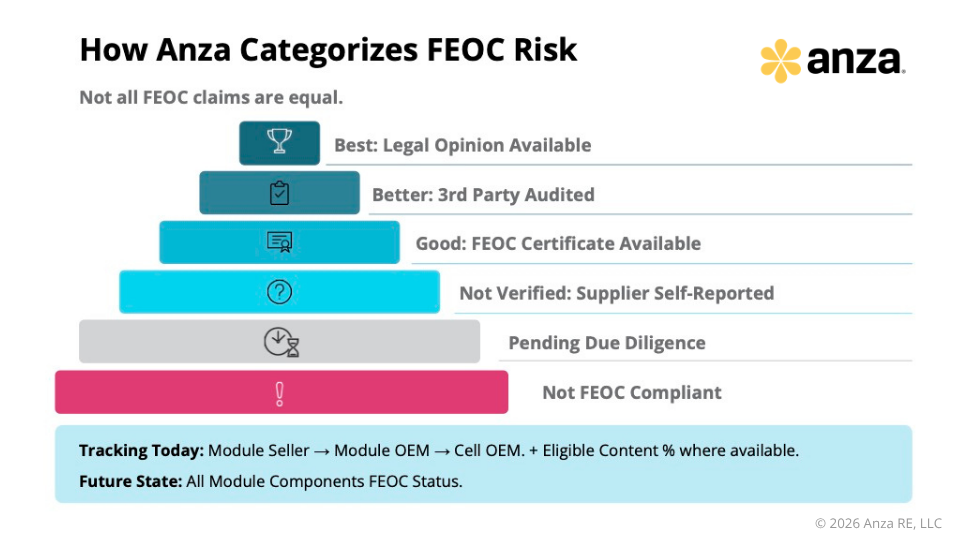
Suppliers that are only self-reporting or haven’t confirmed their PFE status should be avoided for now, and are not qualified as FEOC-compliant on the Anza platform.
If you’re making procurement decisions based solely on whether a supplier says they’re compliant without additional verification, you’re carrying more risk than you realize.
How Anza Helps You Navigate FEOC Compliance
Anza’s solar platform was built specifically to cut through this complexity. Here’s what that looks like in practice:
- Instant compliance filtering: At the earliest stage of project planning, you can apply a simple FEOC compliance filter to see which of the 240+ modules on the platform have verified compliant documentation and what they cost for your delivery window.
- MACR calculations built in: Using IRS safe harbor tables, Anza calculates the Material Assistance Cost Ratio for each module and surfaces it directly in the platform. No manual spreadsheet work required.
- Documentation transparency at the component level: For every module, Anza shows not only a yes/no compliance answer, but the verification tier behind it. That includes whether it’s legal opinion, third-party audit, or certificate, and at the module OEM, cell, and seller level, so you see what’s backing up the claim.
- 10 quarters of pricing visibility: Compliance data lives alongside 10 quarters of pricing in Anza’s quarterly pricing table, so you can evaluate cost trends alongside compliance status across delivery windows in a single view.
- Beyond self-certification: Anza doesn’t stop at supplier certificates. The team works with legal partners and third-party auditors, sends direct supplier questionnaires, and tracks compliance at every supply chain layer, including upstream componentry. Supplier compliance roadmaps are updated quarterly.
See How Greater FEOC Transparency Can Work for Your Projects
Want to see how this process works? In the video below, Anza director of product management Tarn Yates walks through how the filtering is used and how the data is shown in Anza’s platform.
The solar FEOC landscape is still evolving, and compliance today doesn’t guarantee compliance in three months. Anza’s continuous monitoring means your data stays current as the market moves.
If you’re evaluating modules for a project, or just trying to understand what your options will look like at delivery, the compliance and cost picture you need is already in the platform.