
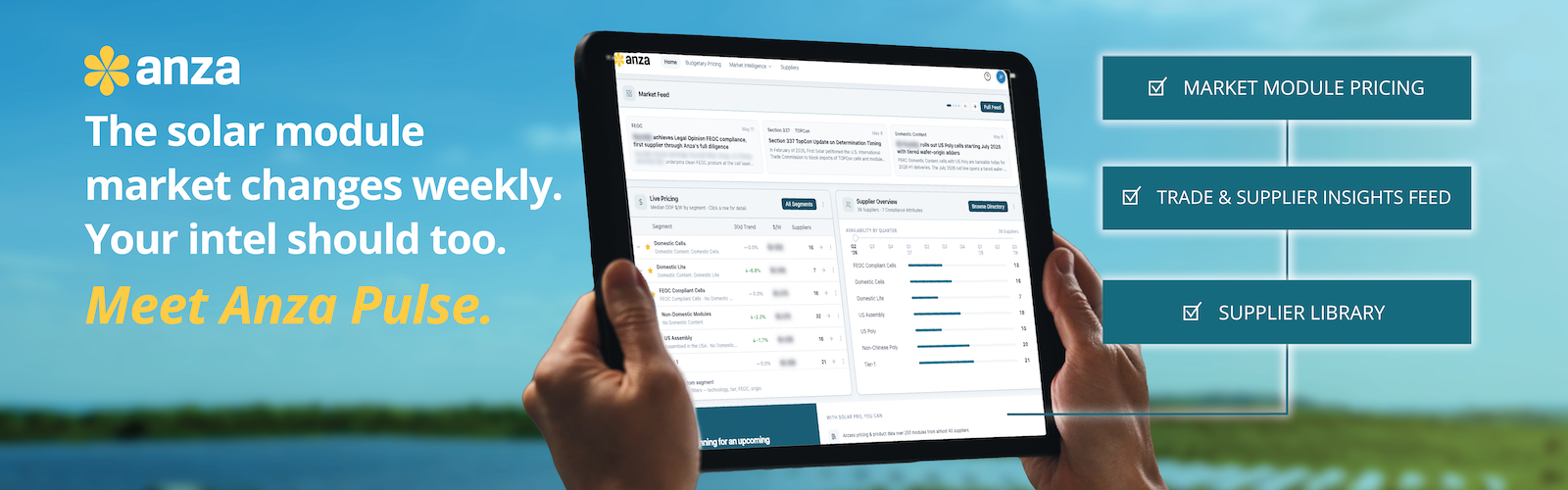
The first on-demand commercial intelligence platform for the U.S. solar module market, built for the decisions teams make 365 days a year, not just when you’re in active procurement.
The problem: a market that moves weekly, intelligence that lands quarterly
The U.S. solar module market gets reshaped every week. A tariff lands. FEOC guidance shifts. A supplier moves on pricing. Another supplier gets acquired or declares bankruptcy. A trade case opens. Each one changes what you can buy, from whom, when, and at what price. The way teams get intelligence about that market hasn’t kept up.
Trying to make decisions in this environment, whether creating a project pro forma, submitting a utility RFP response, deciding if it is worth pursuing the 10% ITC bonus, or evaluating who belongs on a preferred supplier list, requires significant labor – and critically, time – reaching across procurement, development, legal, and policy teams.
For years, the intelligence landscape has been defined by quarterly reports and component-based pricing produced from annual supplier surveys and raw material indexes. None of those sources can keep pace, and by the time the next report ships, the data is already weeks behind where suppliers actually are.
So teams have been forced to choose between two bad options. The first is stale third-party reports that are out of date by week three. The second is a constant treadmill of manual work: multi-week supplier RFI cycles, conference-circuit relationship management, scattered policy headlines, and consultant calls, all of it expensive, slow, and stale by the time it’s stitched together.
The result is that seven-figure decisions get made on the wrong data. Pro formas get built on inflated assumptions. M&A and project-sale negotiations leave value on the table. ITC opportunities get missed because the math couldn’t be run in time. Procurement timing slips through the window where the savings live.
The pain looks different depending on where you sit. Procurement teams react to every policy twist and turn instead of getting ahead of it, and burn weeks rebuilding the same supplier picture every quarter. Development teams carry stale module assumptions into pro-formas, M&A negotiations, and bids. Executives make portfolio-level calls on reports that arrive late and only provide a partial picture.
Anza Pulse closes that gap, providing developers, equipment buyers, and leadership with on-demand access to the data you need between procurement cycles and during development to make faster and better project and business decisions.
How Anza Pulse solves it
Anza Pulse is a data subscription, not software, that delivers always-current solar module intelligence in one place: with live pricing, a vetted supplier directory, a regularly updated policy and trade navigator, defensible budgetary pricing snapshots, and a continuous market feed.
Anza Pulse’s pricing is drawn from 40 module suppliers and more than 1,000 monthly price quotes, refreshed continuously and segmented the way U.S. teams actually plan and buy: by Tier 1 status, FEOC compliance, domestic content, cell technology, frame size, wattage, and assembly origin.
In short: no surveys, no modeled indices, and no quarterly lag.
The result, in Anza CEO Mike Hall’s words, is the data equivalent to running a fresh RFP across every supplier, every day of the year. How that benefits your company in practice depends on which team is using it.
For procurement teams: from reactive to ahead of the market
Procurement wins or loses cents per watt depending on when they buy, and between active buying cycles, they’re the team most exposed to a market that won’t sit still.
The highest-value lever Anza Pulse pulls for procurement is purchase timing. Trade and tariff rules can change overnight, and timing decisions translate to real dollars per watt. Pulse’s Policy & Trade Navigator and Market Feed surface every tariff action, FEOC ruling, and trade case as it happens, mapped to the suppliers and pricing segments it affects, with Anza’s guidance on how to reduce risk. Section 337 buy-early plays alone could mean more than 5¢/W in value added. With Pulse, procurement teams stop chasing the news and start acting on it.
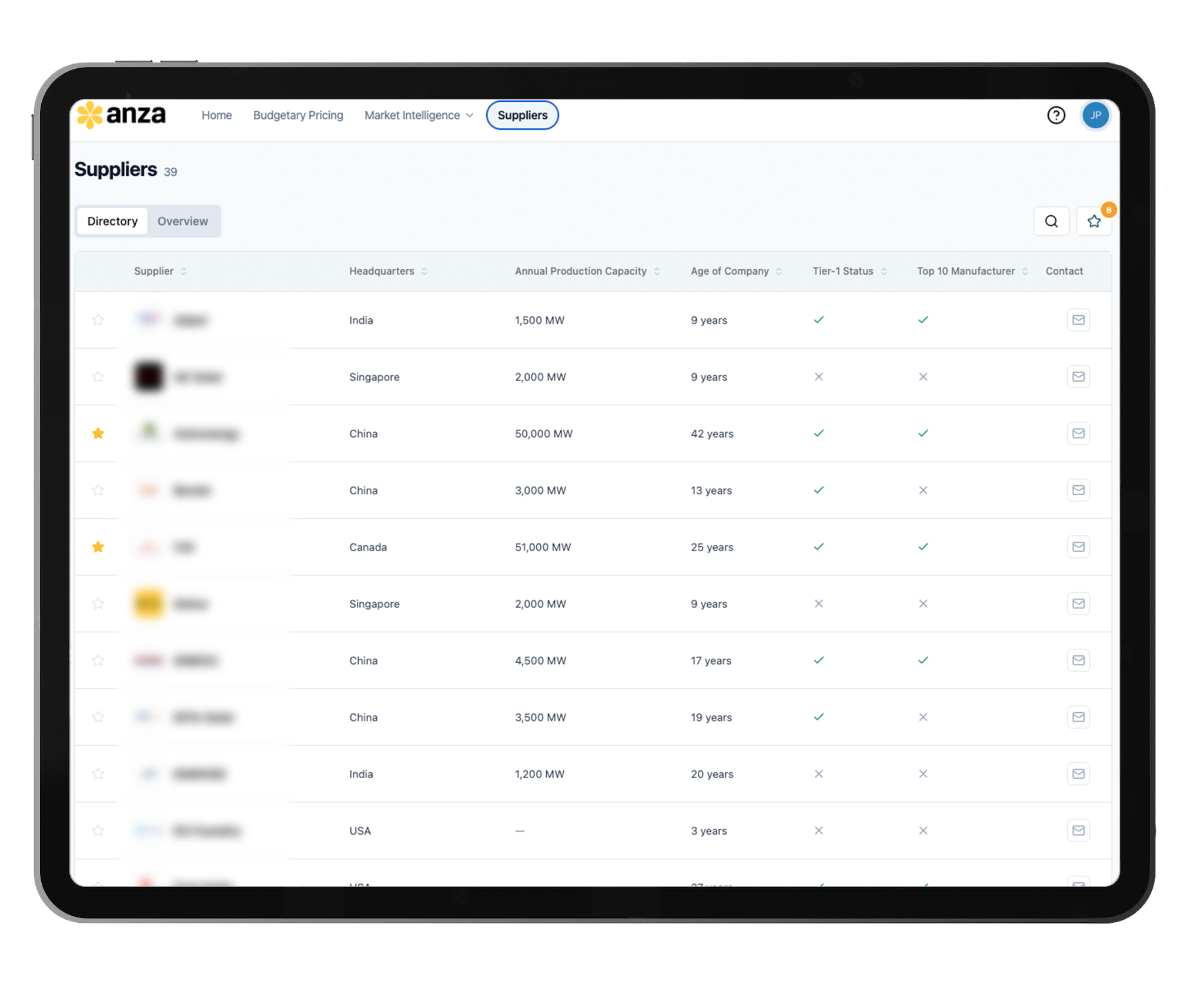
The second value driver is the time procurement teams get back in staying informed when they’re not in active buying. Live Pricing, the Supplier Directory, and the Policy & Trade Navigator work together as one always-fresh operating picture. Weeks of data collection, supplier research, and policy tracking collapse into minutes, and procurement teams walk into every internal review with current pricing, supplier health, and policy intel.
For development teams: better pro formas, stronger negotiations, more wins
Most of a development team’s value-creating decisions get made well before a project ever goes out to bid. Pro formas need module assumptions that hold up under lender, investor, and IPP scrutiny. Projects being sold or acquired need a defensible market view on the modules baked into the valuation. And when an RFP or customer proposal does come up, the same accuracy that protects a pro forma is what wins the work.
The primary driver of value for development is the accuracy of the module assumption baked into the pro forma and at the M&A table. Pro formas built on stale or generic pricing get challenged in lender review, walked back during diligence, and used by IPP buyers to chip away at the development fee during project sale negotiations.
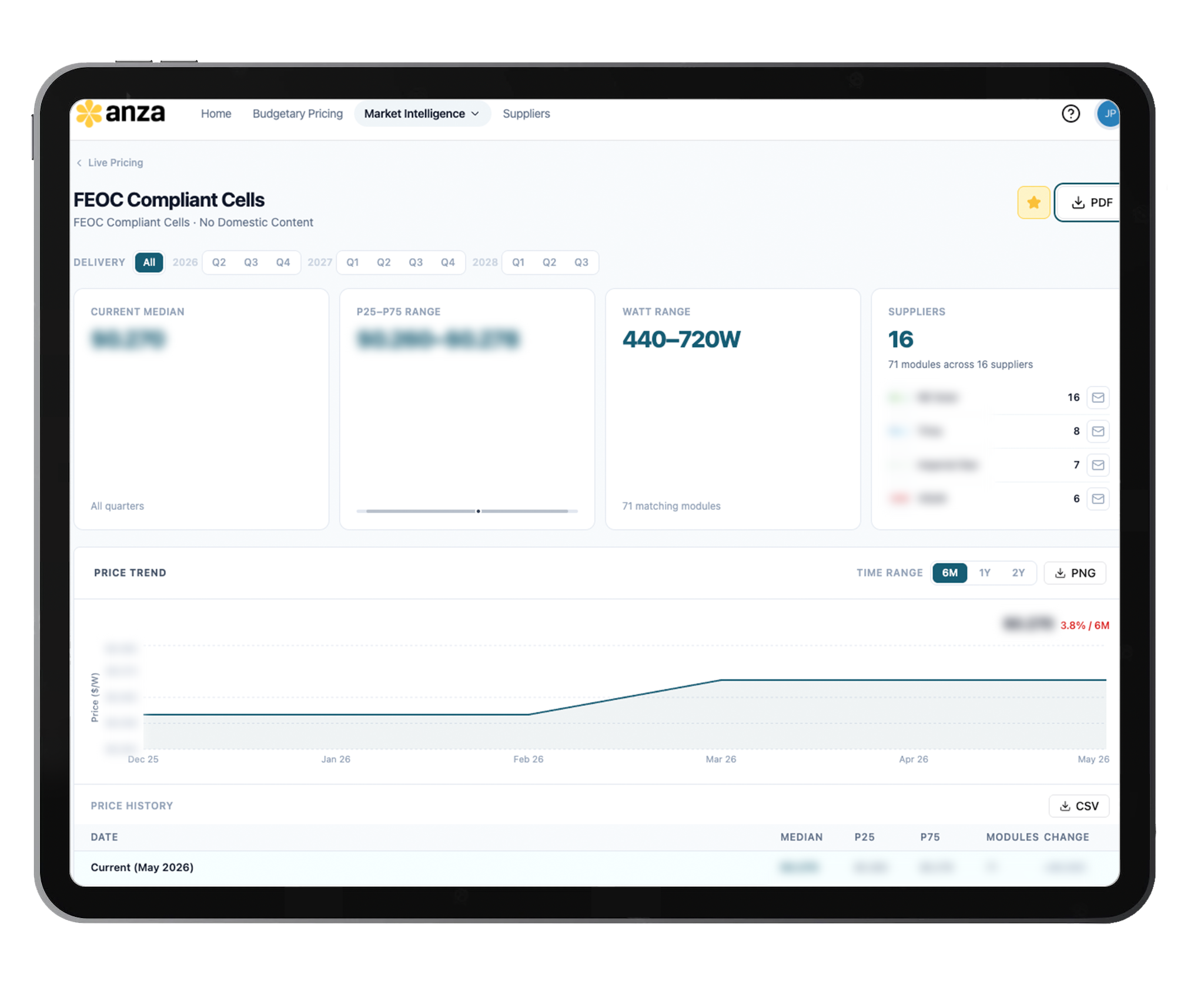
Pulse enables you to start the process with accurate, real-time data. Budgetary Pricing produces project-specific, exportable snapshots adjusted for project location and PO date, with a full audit trail ready for investment committee, lender, or buyer review. During M&A and project-sale negotiations, that same data becomes leverage: developers can validate or challenge a buyer’s module assumptions with a market basis instead of a best-guess number, protecting the development fee and the project’s overall valuation. And when an RFP comes up, the same engine delivers real-time, segmented pricing that wins bids and survives scrutiny.
The second business case for development is securing the 10% ITC bonus on already safe-harbored projects. The decision to chase domestic cells or DC-lite components is a real-money call, and today most developers can’t make apples-to-apples comparisons because they don’t have current pricing across the relevant categories. Pulse’s Live Pricing covers FEOC-compliant, domestic-cell, and DC-lite options side by side, so the ITC pipeline expands instead of being hamstrung by uncertainty.
For the C-suite: see the market, move on it
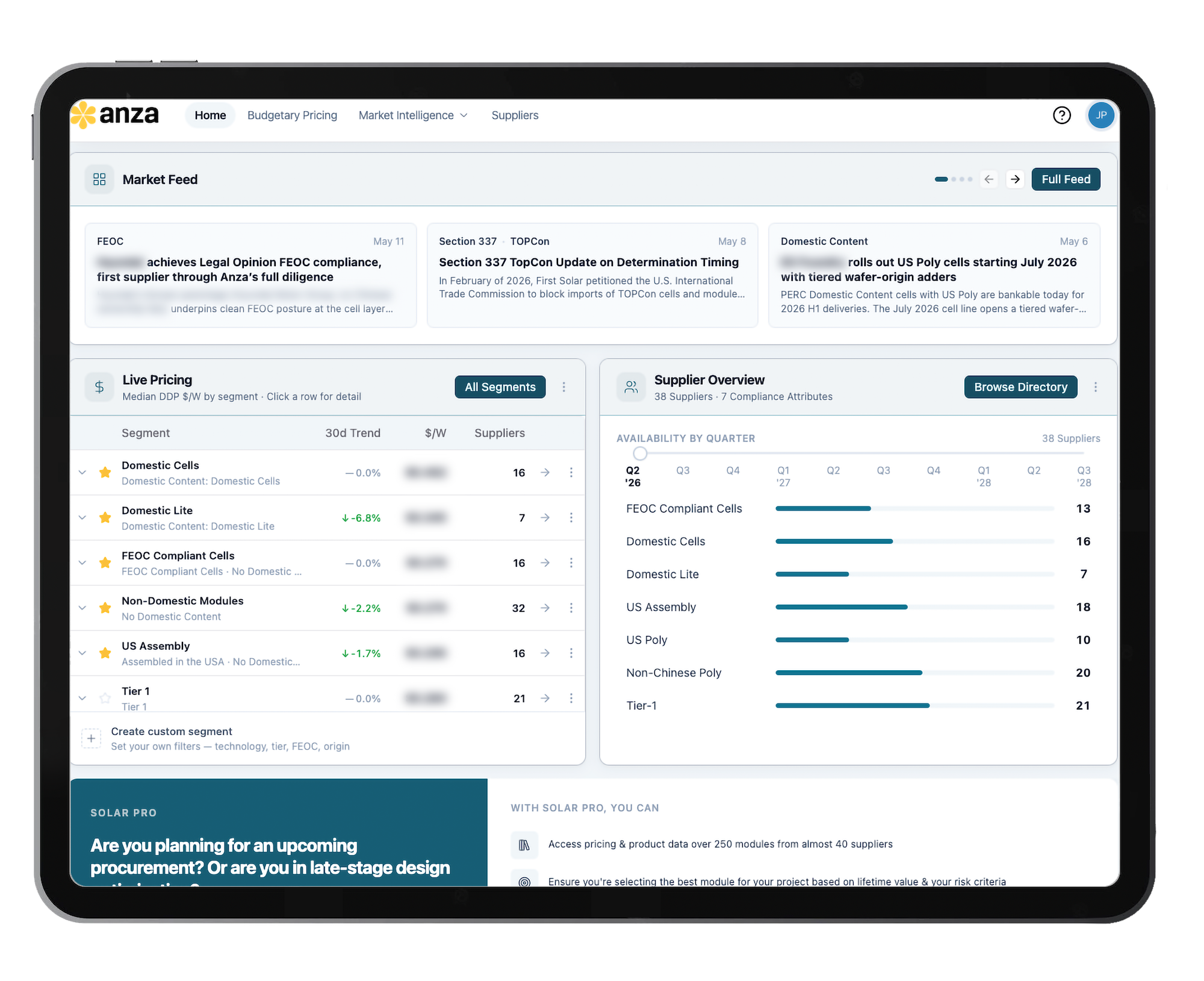
Executives often make portfolio-level calls on safe harbor, ITC bonus pursuit, and preferred vendor list strategy with stale or incomplete information today. Pulse gives them the market-wide view of suppliers, pricing, and trade intel so they can make truly informed decisions.
Consider the decision to keep safe-harboring projects through mid-year. With Pulse, leadership can see the FEOC-compliant supply forming, the premium it carries, and how that premium is moving week over week. That visibility turns a guess into a defensible call, and it can mean the difference between capping the ITC pipeline and expanding it.
The same applies to preferred vendor list changes at the portfolio level, which Pulse supports with direct-from-supplier intelligence that no quarterly report can match.
Beyond their own decisions, executives also receive the reports their teams build, and the same Pulse data flowing through procurement and development shows up in leadership reviews already current and defensible.
What’s built into an Anza Pulse subscription
Six core capabilities baked into Anza Pulse power every one of the workflows above:
- Pulse Dashboard. The continuous operating picture, surfacing the latest market feed items, live pricing for default module categories, and supplier availability by category.
- Live Pricing. Aggregate module pricing across FEOC-compliant cells, domestic cells, DC-lite, non-domestic modules, and U.S. assembly, segmented by delivery quarter (out 10 quarters), tier, cell technology, frame size, wattage, and assembly origin. Every view shows median, P25 to P75 range, supplier counts, and a 6-month price trend.
- Supplier Directory. A vetted directory covering more than 95% of the U.S. module supply, with company financials, bankability notes, factory audit data, contract terms, supply chain risk, and direct contact information.
- Policy & Trade Navigator. A structured library covering FEOC, UFLPA, Sections 232 and 337, AD/CVD, and domestic content, with milestones, issue summaries, and Anza’s guidance on each.
- Budgetary Pricing. Project-specific, exportable snapshots based on delivery quarter, project location, and PO date, with the audit trail that no other source provides.
- Market Feed. Continuously updated policy and supplier news with Anza’s expert take, refreshed at least weekly.
Together, a single platform that’s live, segmented, supplier-sourced, and always current replaces weeks of repetitive labor, freeing your team to put Pulse’s insights and supplier data to work across your portfolio. More importantly, each bid is delivered backed by up-to-date and policy-informed pricing, supporting stronger development outcomes and project valuations.
Get started
Anza Pulse is available now as a standalone subscription. It complements Solar Pro, which delivers module and project-specific procurement and development optimization for teams already in active buying cycles. If your team is making seven-figure decisions based on data from last quarter, you now have a better option. Schedule a demo and see what the market actually looks like today.