

If you’re a C&I or distributed generation energy storage developer or EPC, you’re already likely living with the problem. You’re trying to put together a competitive bid or customer proposal, and you need current pricing and product data, such as FEOC status, safety certifications, technical specs, and commercial wrap availability, but you can’t get it. Not at your project’s scale.
Suppliers prioritize utility-scale buyers and projects, which drive and dominate manufacturing cycles. Distributors give you a narrow slice of the market and pricing that reflects their margins rather than market reality. And the data you do have is often stale: gathered during a previous procurement cycle, already out of date by the time you need it again.
So you likely estimate and use outdated numbers. You may submit a proposal based on incomplete product data or documentation, and then spend the back half of the project scrambling to fill the gaps after you’ve won the work. The result is fewer won bids, slower permitting, narrower margins, and more risk than you want.
But up-to-date data scaled to your needs can solve that. That’s where Anza’s new Energy Storage DG subscription comes in.
Why The Supplier Data Issue Is Harder for C&I and DG Teams
Utility-scale developers have enough deal flow and procurement volume to command supplier attention. They get pricing, documentation, and technical data when they need it. C&I and DG developers and EPCs typically don’t have the same leverage, and because of that, the information utility-scale teams take for granted is effectively inaccessible for everyone else at the bid stage.
Here’s what that looks like in practice: you’re responding to a client RFP and need budgetary pricing for a 2-4 hour AC-integrated system. You need to know which FEOC-compliant products to recommend if you or your client plans to pursue the ITC. You need safety certifications to support your submission to AHJs.
The sticking point: None of that information is sitting somewhere you can access on demand. You either have the supplier relationships to get it, and C&I and DG teams typically only have a few, or you make do without it.
Energy Storage DG gives you what you’ve been missing: on-demand access to the pricing and product data that you previously couldn’t gather without either a large procurement footprint or a lot of time you don’t have.
Touring Energy Storage DG, By How It Helps You


For C&I developers: more credible bids, assurance for AHJs, stronger supplier negotiations
Your workflow starts before you’ve won anything. You’re evaluating whether a project makes economic sense for a customer, looking at demand charges, load profiles, and what duration system fits the economics. Once you know what you’re sizing, you need to know what it costs and whether the products that meet your requirements are actually available.
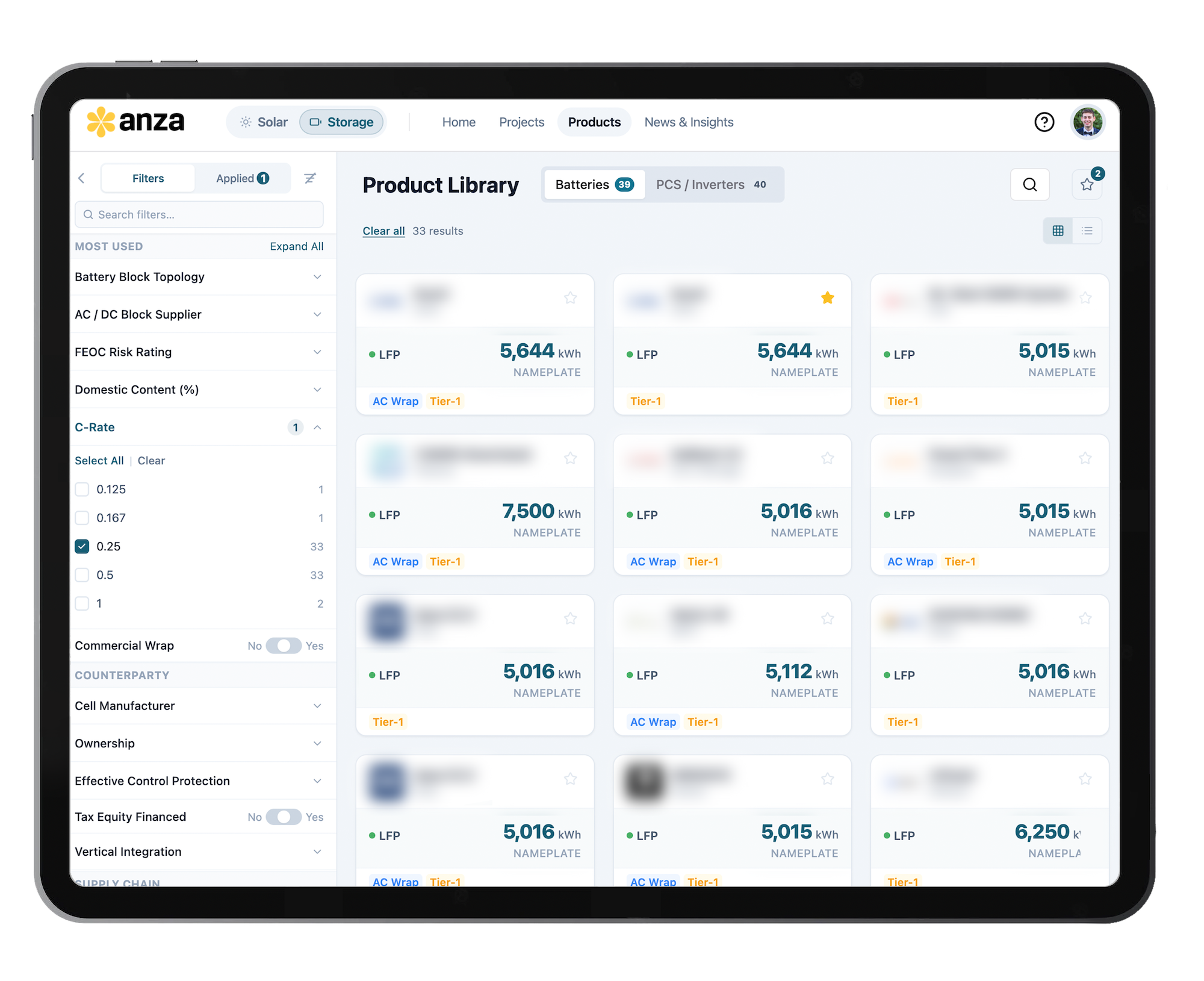
With Energy Storage DG, you can pull current budgetary pricing for AC-integrated systems sized for your project, with east or west coast delivery costs included, and filter the product library by the criteria that matter for your bid: FEOC compliance if you’re pursuing ITC, safety certifications for AHJ submissions, domestic content status, and supplier commercial wrap availability. That data feeds directly into your proposal, so your customer gets a more credible, better-supported bid and your AHJ submission is backed by actual product documentation rather than placeholders. And when you win and move into active procurement, you’re not starting from scratch: you already have a validated shortlist and a stronger negotiating position with suppliers.
For C&I EPCs and integrators: more defensible designs, fewer permitting surprises
You’re often the team that bridges the gap between what the developer sold and what actually gets built. You need accurate technical data to design the system, compliance documentation to move through permitting, and pricing visibility to protect your margin.
Energy Storage DG gives you the product library depth and technical detail to work faster and with more confidence. The platform makes it easy to evaluate PCS variants, understand supply chain origin and FEOC risk, and compare containerized versus non-containerized configurations, all in one place, filterable, and current. For EPCs more likely to explore DC-integrated configurations, supply variants are surfaced alongside AC-integrated options, so you can evaluate what actually fits the project technically and commercially. The result is faster, more defensible designs and fewer surprises in permitting.
For DG developers: better modeling, more informed negotiating position
Your challenges look a lot like the utility-scale problems Anza already solves — you need product strategy, early-stage pricing, and supply chain visibility across development phases — but your deal size doesn’t always command the supplier attention that utility-scale teams get.
Energy Storage DG right-sizes the data-driven approach Anza applies at utility scale down for the DG segment. Your team can evaluate products using current market pricing, run early-stage financial models with confidence, and establish your basis of design before you’ve committed to a procurement. The most important shift is timing: when you’re ready to go to suppliers, you’re not negotiating blind. You already know which products fit your requirements and roughly what market pricing looks like, which means you enter procurement from a position of strength rather than starting from zero.
How Energy Storage DG Sets Bids Up for Success
Energy Storage DG is a data subscription, not a complex software implementation. At its core, it gives you current budgetary pricing for storage systems sized for C&I and DG projects, with volumetric pricing breakdowns and delivery cost inputs so the numbers reflect your actual project economics rather than a national average.
The searchable product library lets you filter across Tier 1 suppliers by FEOC compliance status, domestic content eligibility, safety certifications, technical specifications, and commercial wrap availability.
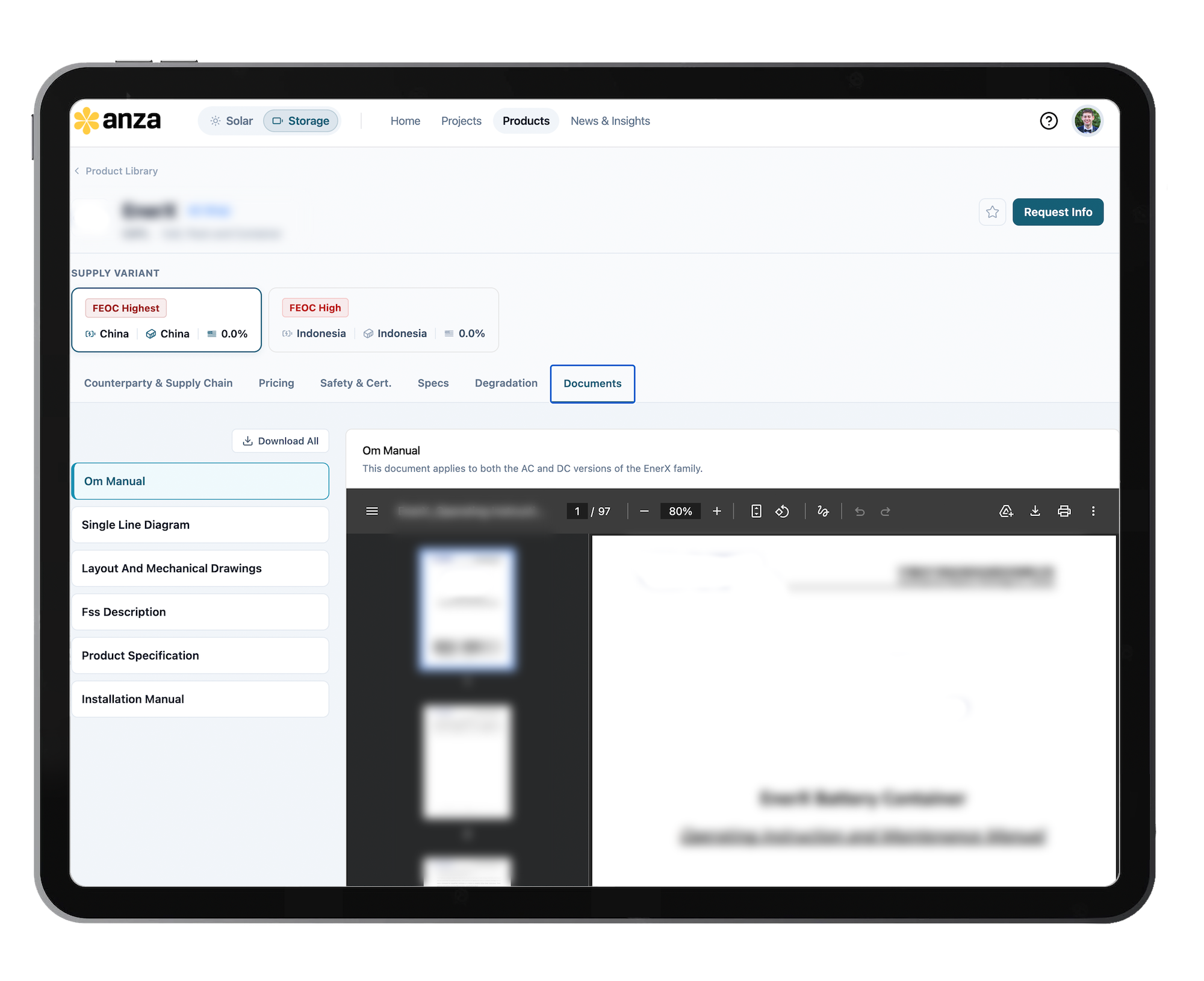
Alongside pricing, you get the supply chain context (manufacturer and commercial wrap provider, manufacturing location, and FEOC risk assessment, for example) that strengthens your bids and better informs your procurement decisions. And when you need to move through permitting, safety and certification data is accessible directly from the platform to support AHJ submissions and interconnection applications.
The cumulative effect is that by the time you’re ready for active procurement, you already know which products meet your requirements and what they should cost. That’s a meaningfully better starting position, both with suppliers and with your clients.
Comparing Energy Storage DG & Energy Storage Pro
Energy Storage DG is built specifically for C&I and distributed generation teams. It’s a standalone subscription priced to reflect the deal sizes and project economics in this segment. It is the entry point for DG storage developers.
Energy Storage Pro, by comparison, is built for utility-scale and large volume DG workflows and includes advanced configuration modeling, lifecycle cost optimization, capacity maintenance planning, and in-depth product and supplier data. If your work spans both DG and utility-scale projects, Energy Storage Pro delivers the data and workflows for both project scales.
See What You’ve Been Missing
The gap between what you need to know and what you can actually access at bid time is a real competitive disadvantage. Energy Storage DG closes it.
Schedule time with our team to learn more.