
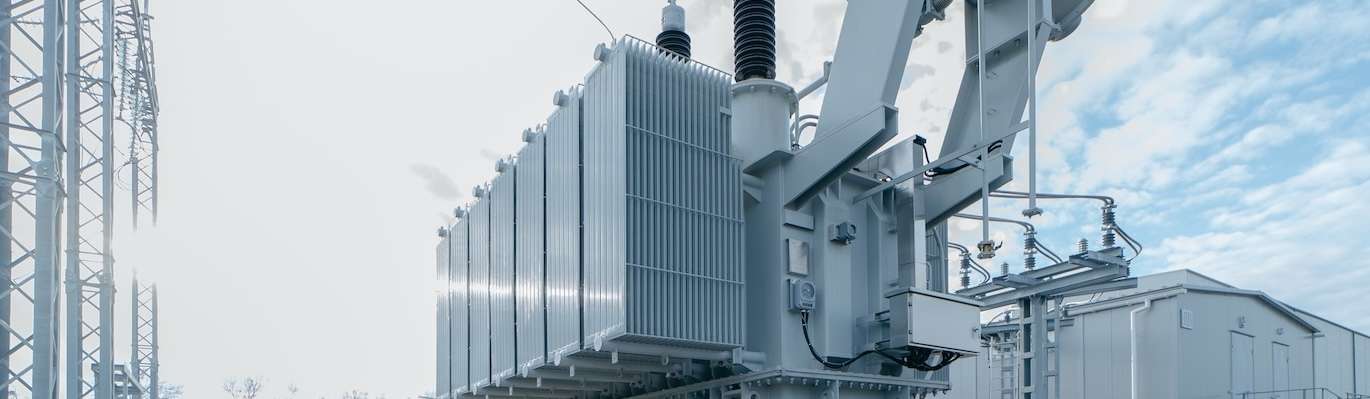
If you’ve tried to buy a transformer in the past year, you already know the market isn’t getting any easier to manage. Buying a transformer today often means making a high-stakes decision with incomplete information. Power transformer manufacturers’ lead times keep growing, prices swing widely, and new bulk power system Executive Order 14421 has added another layer of supplier diligence to every procurement. Getting any of this wrong can delay energization, erode project economics, or put tax credits at risk, and many teams lack the resources to manage the process. Here’s where the market stands and the practices we see helping solar and storage developers move faster with less risk.
Market Challenge #1: New bulk power system Executive Order raises the diligence bar
On August 26, 2026, President Trump signed Executive Order 14421, declaring a national emergency under IEEPA over foreign-produced equipment used in the U.S. bulk-power system. The order covers transformers, inverters, battery storage systems, circuit breakers, generation turbines and reactors, control systems, and any associated critical components, software, firmware, and remote access used for the transmission grid.
While not a blanket ban, its reach is broad. It targets equipment tied to Covered Foreign Entities, such as countries under U.S. sanctions or arms embargoes, with China and Russia the most relevant for transformer equipment. The Department of Energy must issue implementing rules by December 24, 2026, so many details are still unsettled.
For transformer buyers, the impact comes down to added diligence and uncertainty. Suppliers will need closer vetting not only on ownership and where components are made, but also on where they were designed and developed. Contracts and financing documents will likely carry more foreign-equipment risk provisions.
Options to accelerate lead times have narrowed significantly post-EO. Previously, using Chinese bushings was a way to get faster delivery as lead times for IEEE bushings increased substantially. Until further guidance on the scope of “critical components” is provided, Chinese bushings are no longer an option.
Market Challenge #2: Transformer lead times keep increasing
HV transformer and HV circuit breaker lead times are now running from 2 to 4+ years. These numbers continue to rise and may cause costly project delays. Medium voltage (MV) transformer procurement has not yet seen a drastic increase in lead times, as many more options are available and they take less time to manufacture. However, teams on tight timelines may still struggle to get MV transformers for their projects.
Increased demand is the main driver. Many developers used transformers as a primary way to safe harbor solar projects in the rush to start construction ahead of July 4, 2026. Data centers, electrification, and grid modernization are all competing for the same factory slots as renewable energy projects. Manufacturers are filling capacity through 2030 and beyond, and bushing lead times have also recently increased. Even the quoting step adds time: some suppliers take 2 to 3 months to return a firm, bindable price, and many project schedules simply don’t have that time to waste.
Market Challenge #3: Transformer pricing variances make benchmarking difficult
Beyond the lead-time challenges outlined above, transformer prices are up roughly 70% since 2020 and continue to climb. One of the biggest issues for buyers is the spread between quotes, where identical specifications can draw prices that differ by 50% or more.
Our transformer procurement service team continues to see price variations from tens of thousands of dollars to millions.
In a recent Anza RFP for a 210 MVA 345kV/34.5kV transformer, we received DDP transformer quotes ranging from $5.38M to $9.05M. In another RFP, a 190 MVA 115kV/34.5kV unit for a safe harbor project drew quotes ranging from $3.7M to $7.4M. Even at the smaller end, a 2.5 MVA 34.5kV/600V pad-mount transformer for a different safe harbor project drew quotes ranging from $70K to $188K.
A buyer who collects only two or three quotes has no way of knowing where they fall in that range. And the lowest price isn’t always the best value once you factor in lead times, quality, delivery history, and contract terms.
Market Challenge #4: Market opacity hides better options
Long lead times, wide price swings, and new federal restrictions would be difficult enough on their own. What makes them harder is that most buyers are navigating them with a limited view of the market. Many developers rely on the same few familiar suppliers, and that narrow view turns each of the challenges above into a bigger problem.
When transformer lead times stretch into years, a short supplier list leaves few places to turn if a preferred manufacturer is out of capacity or quotes a delivery date that breaks the schedule. Suppliers with open production slots or faster timelines may exist, but teams without visibility into the wider market won’t find them in time. Relying only on familiar suppliers means buyers may leave significant value on the table without realizing it.
The new bulk power system Executive Order adds another layer of complexity. When DOE’s rules restrict certain suppliers, buyers who depend on a small group of vendors could see their options shrink even further. Replacing a supplier late in the process is costly and slow, especially when new transformer manufacturers still need vetting for technical capability, quality, ownership, and compliance. Buyers with a broader market view can adapt quickly. Those without one are left to accept whatever their usual suppliers can offer, often at the expense of schedule, price, or risk.
Best practices for transformer procurement today
As challenges add up, the most important step is locking in production slots early. Manufacturing lead times start at contract execution, not at RFP, so every week spent collecting quotes or negotiating terms cuts directly into your schedule. Moving early also keeps more suppliers in play, since available capacity keeps shrinking.
Tracking timing in three separate stages helps ensure realistic planning and prevents bottlenecks in site design and construction:
- Quote speed, meaning how long a supplier needs to return a firm price.
- Engineering drawing approval. We’re seeing initial drawings arrive 2 to 16 weeks after the PO, and your site design can’t be finalized without them.
- Total time to site, which covers manufacturing, factory testing, and delivery.
Asking about each stage separately gives you a much more realistic picture of your schedule than a single lead time number.
Accurate upfront specifications also save significant time. Voltage, capacity, efficiency, cooling, protection, and environmental requirements all determine which transformer manufacturers can actually bid. Incomplete specs waste RFP cycles. If you need flexibility, decide early which parameters can stay open and which must be locked.
Supplier ownership and component origin now deserve a place near the top of your evaluation. Beyond ever-evolving tariff risks, EO 14421 requires you to address grid-connection risk. Find out where components are manufactured, where the unit is designed and assembled, and who owns the company to ensure you meet your criteria and minimize risk.
When comparing bids, focus on lowest evaluated cost rather than lowest price. That means weighing quality programs, third-party inspections, on-time delivery history, U.S. service presence, customer references, and how closely the supplier’s terms align with your commercial requirements. For newer market entrants, look at their track record in other regions, their parent company and investors, and who will handle warranty or quality issues in the U.S.
How Anza can help
Anza’s Transformer Procurement Service works as an extension of your team, managing the full process from building a shortlist through RFP, best and final offer, negotiation, and post-PO support. We stay in active communication with 50+ suppliers across 12+ countries to keep the latest information, which lets us cut supplier identification from about three weeks to about 30 minutes. Our data tracks quote speeds, lead times, manufacturing locations, and tariff and supply chain exposure.
The results speak for themselves. Anza has supported 5 GVA of transformer purchase orders in the last year and procured more than 150 safe harbor transformers. Two recent projects show what this looks like in practice. When a 190 MW solar project’s only transformer supplier couldn’t deliver ahead of a safe harbor deadline, Anza ran a multi-manufacturer search and placed the PO roughly 10 weeks early. When another developer’s preferred supplier had no capacity, we surfaced 10 qualified manufacturers with safe harbor documentation, payment terms, and references in under four weeks, giving them a validated shortlist for the next time they hear no.
With capacity filling and new federal rules on the way, now is the time to get ahead of your next transformer procurement. Our team can help you accelerate and de-risk your MV/HV transformer and HV circuit breaker procurement. Contact us to learn more about how our experts can help.